Author: Web-Observer

  • Anthropic Details How Dreaming Organizes Claude Agent Memory (2026)

    Anthropic Details How Dreaming Organizes Claude Agent Memory (2026)

    Takeaway: On November 6, 2026, Anthropic published The components of agent memory, an engineering research post by Lance Martin that explains how Claude keeps knowledge between sessions — and how an offline process Anthropic calls dreaming reorganizes that memory. The post is not a claim that Claude updates its model weights while it “sleeps.” Dreaming reads session transcripts plus an existing memory store, then writes a new, cleaned-up store: duplicates merged, stale or contradicted notes replaced, and new representations (including linked wikis) added. In Anthropic’s headline evaluation, Claude built a wiki over about 350,000 internal files (~420 million tokens) from Stainless, a software company Anthropic says it acquired in May. After 128 dreaming sessions, scores on 25 questions rose from 13% to 48% when Claude used only the wiki; combining the wiki with search reached 61%, versus 53% for search alone, and saved about 20,000 tokens per question.

    This is a research explainer about memory design for long-running agents. It is distinct from this morning’s METR assessment of Anthropic’s R&D pace, from Claude API message threads, from Claude Personal Finance, from FlashProve, and from this week’s security write-up of Claude Code settings files leaking secrets on GitHub. Dreaming itself was already documented earlier in 2026 as a research-preview feature for Claude Managed Agents; the November 6 post is the lab’s public evaluation of how memory and dreaming actually behave.

    What Anthropic means by memory — and what it does not

    Anthropic defines agent memory as knowledge Claude gains from experience — user interactions and assigned tasks — and retains between sessions as context it can read later. The post explicitly excludes three other mechanisms: changes to model weights, in-context learning inside a single conversation, and compaction (summaries that replace older turns so a chat can continue in a new context window).

    The analogy the authors use is human memory consolidation. People encode experience quickly, then replay and distill some of it during sleep or quiet rest. Researchers at Letta and UC Berkeley previously described “sleep-time compute” as a way for models to reorganize context between interactions. Anthropic applies a similar split: write notes while work is happening, then dream offline to clean, correct, and restructure those notes before the next session.

    A memory note is also a prediction. When Claude writes down a rule or a verified fact, it is betting that a future session will need that information without repeating the original work. A wrong prediction is dangerous precisely because later sessions may trust the note.

    Stronger models got better at judging what to save

    Anthropic reports several evaluations rather than a single leaderboard. On Continual Learning Bench (CL-Bench) 1.0, Claude answered a series of database questions in fresh sessions, with only a persistent memory directory carrying over. After each answer it learned the correct solution and could write a note for later questions.

    Different model generations used that loop differently:

    • Claude Sonnet 4.6 generated theories about mistakes but left a scattering of files full of untested guesses.
    • Claude Opus 4.7 consolidated notes into a single reference and started marking which facts it had checked.
    • Claude Sonnet 5 marked answers as confirmed after the grader checked them and wrote corrections when it had been wrong.
    • Claude Opus 5 was the first of the set to close the loop: most entries included a rule, how Claude knew the rule was true, answers to earlier questions, and warnings about traps.
    • Claude Opus 5.5 and Claude Sonnet 5.5 also closed the loop. With memory, both scored about the same as Opus 5, though their no-memory baselines were slightly higher.

    The lab also found that telling stronger models exactly what to write can backfire. A rule to “record only failures” removed much of the performance boost memory had given Opus 5 and Opus 4.7. Anthropic’s usual guidance for frontier Claude models is simpler: create notes when a person asks or when something is clearly worth remembering, and leave the salience judgment to Claude. Older models needed more explicit prompts — for example, telling Sonnet 4.6 to read its memory files and test its theories nearly doubled its benchmark score.

    Pokémon as a test of salience, not just storage

    To test what Claude thinks is worth remembering, Anthropic compared memory folders from Claude Sonnet 3.7 and Claude Fable 5 about 10,000 steps into Pokémon Red:

    ModelMemory folder around step 10,000Progress reported
    Claude Sonnet 3.7413 memory files across 225 foldersOne badge
    Claude Fable 5Nine files in two folders, plus a top-level global.mdFour badges
    Claude Opus 5.5A small folder tracking the current goal and next stepsBeat the game, per Anthropic

    Sonnet 3.7 treated almost everything as memorable — separate files for battles, items, and characters — and then spent turns filing memories instead of playing. Around step 10,000 it started a fourth folder of “master” files and, over the next 17 steps, created six files and deleted nine others without taking an in-game action. Fable 5 used memory for things the game did not already display on screen: strategy, plans, and tested rules. Its global.md held the current goal, a gym plan, and the model’s own rules for using memory.

    The contrast is the point Anthropic wants readers to take: more memory is not better memory. Notes that duplicate state the agent can reread every turn go stale immediately. Notes that capture a hard-won rule disappear unless someone writes them down.

    Dreaming can correct a note that would otherwise be trusted

    Because Claude writes memory in the moment, a bad note can be reused confidently later. Dreaming gives Claude a second look against the original transcript. Anthropic’s example is a Pokémon navigation error in Mt. Moon. Claude used a PokéCenter as a landmark and wrote down the wrong side of the mountain for that building. It then concluded “Mt Moon DONE,” walked off a one-way ledge, and never reached Cerulean City in that run — dropping back onto the earlier route three times before appearing to give up.

    When Anthropic ran dreaming on the folder that contained the wrong location, Claude checked the note against the transcript, rewrote it, and — with the corrected memory — went back into the cave and eventually reached Cerulean City. The uncorrected-memory run and a no-memory run both failed to get past the mountain, according to the post.

    Wikis: 13% to 48% on a 350,000-file corpus

    Dreaming can also build new representations. One of those is a wiki: pages Claude writes and maintains about a subject, with links that act as a map through a growing knowledge base. Anthropic tested this on a corpus of about 350,000 internal Stainless files (roughly 420 million tokens) and a 25-question evaluation set.

    Opus 5 agents spent 128 sessions exploring the files, writing or correcting linked pages, merging duplicates, and checking claims against sources. They used a shared log to coordinate:

    SetupResult Anthropic reportsWhat it does not prove
    Wiki only, after 2 dreaming sessions13% of graded criteriaThe wiki is not yet a substitute for search
    Wiki only, after 128 sessions48%Still below search; the wiki is incomplete
    Search tool alone53%No structured memory map
    Search plus the grown wiki61%; about 20,000 fewer tokens per questionGains are task-dependent, not universal

    Wikis helped most when questions required combining information across documents. On 24 questions about a merger, more than half of which needed several documents — and many of which also needed judgment or math — Claude scored 87% with the wiki versus 73% with search alone. On some Harvey LAB legal-brief tasks, criteria could be retrieved from a single document with text search, and the wiki showed no clear gain. In another case the wiki grew larger than the source documents themselves, abstracting almost nothing — Anthropic compares that failure mode to Borges’s map the size of the empire.

    Instructions change what dreaming keeps

    Dreaming can be pointed at a goal. On a LAB acquisition task graded against contract terms, several agents wrote to one shared table at the same time. Only 41 of 57 graded facts (72%) survived into the wiki. After a loop in which Claude reflected on failures and rewrote the wiki-building instructions, each contract got its own page, written by a single agent that quoted terms instead of summarizing them into a contested table. The brief generated from that wiki then met 57 of 57 criteria.

    A second dreaming pass also closed gaps a live session left behind. On one task, dreaming found nine links to a missing page and repointed them to an existing page for the same document, then added three new pages including an index.

    Anthropic notes a related constraint from Claude Code’s auto memory: Claude does not load an entire memory file into every session. It loads only the first 200 lines or 25 KB of MEMORY.md. That header is an index. Dreaming’s job at the top of the hierarchy is to keep that injected layer small, because a wrong note loaded into every session wastes tokens and can steer later work off course. Longer instruction files, Anthropic’s own Claude Code documentation already warns, also reduce adherence.

    Open questions the post leaves on the table

    The authors flag design problems that are not solved:

    • When should Claude write memory during a task (immediate, but distracting) versus push that work into a later dream (less disruptive, but not instantly available)?
    • How often should dreaming run, and which memories are worth the compute to re-check, given that notes can be wrong from the start or drift as the environment changes?
    • When is a searchable transcript enough, and when does a maintained representation such as a wiki pay for itself?
    • How do you stop representations from accumulating errors — or growing until they are no smaller than the raw files?

    Anthropic’s stance is pragmatic rather than triumphant: frontier models have gotten better at judging salience, but no model can know what a future session will need. Dreaming is a way to spend compute looking backward so later sessions can look forward with a cleaner map.

    What this is — and what it is not

    ClaimStatusNotes
    Anthropic published “The components of agent memory” on November 6, 2026ConfirmedEngineering post by Lance Martin
    Dreaming updates Claude’s model weights overnightNot what Anthropic claimsMemory is stored context, not training
    Dreaming reorganizes an existing memory store using past session transcriptsConfirmed in the post and docsInput store is left intact; output is a new store
    350,000-file Stainless corpus; wiki-only scores 13% → 48% over 128 sessionsReported by AnthropicInternal documents; we did not re-run the eval
    Search plus wiki reached 61% vs. 53% for search aloneReported by AnthropicAbout 20,000 tokens saved per question
    Wikis always beat searchNot claimedSome single-document tasks showed no gain; one wiki outgrew its sources
    This post is the first public mention of dreamingNoManaged Agents docs already describe dreams as a research preview
    This is the same story as METR’s November 5 R&D-acceleration reportNoDifferent question, dataset, and authors

    FAQ

    Does dreaming mean Claude trains itself while idle?

    No. Anthropic is describing an offline job that reads transcripts and memory files, then writes a reorganized memory store. The post says this is separate from changing model weights.

    Is this a new product launch?

    Not in the sense of a first announcement. Dreaming is already a research-preview capability for Claude Managed Agents, with API docs and a request-access path. The November 6 post is the research write-up of how memory notes, salience, wikis, and dreaming interact — including new evaluation numbers.

    Do I need Managed Agents to benefit from the idea?

    The productized dream job is documented for Managed Agents. The broader lesson — write sparse, tested notes during work, then spend idle compute cleaning them against transcripts — also shows up in Claude Code’s auto-memory design, where only a small header of MEMORY.md is injected into each session.

    Why did a smaller memory folder beat a huge archive in Pokémon?

    Because the game state changes constantly. Sonnet 3.7 stored details the screen already showed, so those notes went stale and then competed for attention. Fable 5 stored plans and rules the game would not remember for it. Anthropic’s argument is that salience beats volume.

    Should teams treat the 13% to 48% wiki result as a general benchmark?

    No. It is one internal 25-question set over one company’s document corpus, reported by Anthropic. The same post shows tasks where a wiki added little and a case where the wiki became larger than the files it was meant to summarize.

    Sources: Anthropic — The components of agent memory (Lance Martin, November 6, 2026); Claude Docs — Dreams; New in Claude Managed Agents: dreaming, outcomes, and multiagent orchestration. Figures and examples above are taken from those pages. We did not independently rerun Anthropic’s evaluations or inspect the Stainless corpus.
  • GitHub Actions Will Block pull_request_target by Default on December 2 (2026)

    GitHub Actions Will Block pull_request_target by Default on December 2 (2026)

    Takeaway: GitHub said in a November 2, 2026 changelog that starting December 2, 2026, GitHub Actions will block pull_request_target events by default in all public repositories, unless an Actions event policy explicitly allows them. Enforcement had previously been scheduled for November 2 and was delayed. Before the permanent switch, GitHub will run two short “brownouts” — November 9 and November 16, 2026, each from 16:00–18:00 UTC — when the default rule temporarily behaves as if it were already enforced. During those windows, blocked workflow attempts create failed runs with an error annotation and do not execute. Private and internal repositories are not affected, and neither is GitHub Enterprise Server. GitHub’s own guide to using pull_request_target securely explains why the trigger is powerful, how people commonly break its safety model, and how to review policy insights before the first brownout.

    This is a CI-policy story for maintainers of public repos, not another secrets-in-the-wild roundup like Claude Code settings files on GitHub, and not a recap of GPT-6 Cyber or OpenAI’s Linux kernel vulnerability pipeline. The hook is practical: the first brownout is on November 9 (00:00–02:00 on November 10 in Asia/Shanghai; 08:00–10:00 a.m. Pacific). If a public repository still relies on pull_request_target without an allowing policy, those two hours are a live fire drill.

    The dates that matter

    MilestoneWhenWhat GitHub says happens
    Original enforcement targetNovember 2, 2026Delayed; the changelog says enforcement was previously scheduled for that day
    Evaluate mode (now)Until December 2, except during brownoutsMatching runs continue, but policy insights show which ones the default rule would block
    First brownoutNovember 9, 2026, 16:00–18:00 UTCDefault rule temporarily enforced; blocked attempts fail with an error annotation and do not run
    Second brownoutNovember 16, 2026, 16:00–18:00 UTCSame temporary enforcement
    After each brownoutImmediately afterwardThe default rule returns to evaluate mode; workflows can run again with warnings
    Permanent default blockDecember 2, 2026pull_request_target is blocked in public repos that still rely on the default policy, unless an applicable Actions event policy allows it

    GitHub introduced the default rule through workflow execution protections. For public repositories that do not already have an applicable Actions event policy, GitHub adds a default policy that blocks workflows triggered by pull_request_target. That default does not replace a policy you already configured, and it does not apply to private or internal repositories.

    Who is in scope

    Repository or productAffected by the default block?Notes from GitHub
    Public repos on GitHub Free, Team, or Enterprise CloudYesThis is the population named in the changelog
    Private repositoriesNoUnchanged by this default rule
    Internal repositories (Enterprise Cloud)NoUnchanged by this default rule
    GitHub Enterprise ServerNoExplicitly excluded
    Repos that already have an applicable Actions event policyThe new default does not replace that policyYour existing allow/deny rules remain the ones that apply

    If every workflow you care about already uses pull_request rather than pull_request_target, you may have nothing to change — the default block is then doing the job GitHub intends. The people who need to act are maintainers whose public automation still depends on the privileged trigger: labeling or triaging pull requests from forks, posting authenticated status checks, or any other job that was written to run with the base repository’s secrets.

    What pull_request_target actually does

    GitHub’s security guide draws a sharp line between pull_request and pull_request_target. A pull_request workflow (and the related review events) runs the workflow file from the pull request’s merge commit. For a fork, that commit is controlled by someone who does not have write access to your repository. GitHub therefore gives those jobs a read-only GITHUB_TOKEN, withholds other secrets, and applies fork-approval policies so the untrusted workflow cannot quietly spend your secrets or your compute.

    pull_request_target flips the trust model. The workflow file — and a default actions/checkout that does not pin another ref — comes from the base repository’s default branch, not from the pull request. Because only that already-trusted workflow is supposed to run, GitHub grants the job the same class of trust it gives collaborator-triggered events such as push: the base repository’s GITHUB_TOKEN and access to repository and organization secrets.

    That combination is why the trigger exists. Automation that must comment on a fork’s pull request, apply labels, or publish an authenticated check often cannot do its job with a read-only, secret-less token. It is also why a mistake is expensive. The safety property holds only while the privileged job treats the pull request as data to inspect, never as code to execute.

    Why GitHub is changing the default

    The changelog’s one-sentence rationale is the same idea as the longer security guide: pull_request_target runs in the base repository’s context and can read its secrets. If a workflow then executes untrusted code from a fork, that code can compromise the pipeline or steal those secrets.

    GitHub’s docs describe the usual failure mode without requiring a novel attack write-up. Maintainers sometimes pick pull_request_target because they want fork pull requests to run CI and they want secrets (for example a private package registry). To test the contributor’s changes, they point checkout at the pull request’s head (or merge ref), or they fetch the fork some other way, and then they build or test whatever landed in the working directory. The workflow file is still the trusted copy from the default branch. The code that subsequently runs — a Makefile, npm install, a test script, a project hook, a dependency’s install step — can come from the fork.

    GitHub and the GitHub Security Lab call that class of bug a “pwn request.” The security guide notes that the same pattern is not unique to this one event: any secret-bearing workflow (issue_comment, workflow_run, and others) can recreate it if it downloads and runs untrusted pull-request code or treats artifacts from a fork’s workflow as trusted input. The December 2 default is a product-level attempt to make the highest-risk trigger opt-in for public repositories, not a claim that every other event is automatically safe.

    What the November brownouts will feel like

    Think of the brownouts as two scheduled two-hour rehearsals, not as the final outage. GitHub will temporarily enforce the default protection so you can see affected workflows before December 2.

    • During the window: pull_request_target attempts that the default rule would block, in affected public repositories, become failed runs with an error annotation. The workflows do not execute.
    • After the window: the default rule goes back to evaluate mode. Workflows can run again; insights and warnings remain the way to see what December 2 will permanently stop.
    • Private and internal repositories are not part of this drill.

    If your open-source project uses pull_request_target for something user-visible — a greeting comment, a preview deploy, a required status check — the brownout is when that automation silently (or noisily) disappears for two hours. Better to find that on November 9 than on December 2, when the change stops being temporary.

    How to prepare before November 9

    GitHub’s changelog points maintainers at Insights to see which workflow runs the rule would block, then offers two paths. The security guide says the same thing in slightly more operational language: while the policy is in evaluate mode, review policy insights and decide, for each affected workflow, whether pull_request_target is still required.

    1. If you do not need the privileged trigger, change the workflow to a safer event where appropriate — GitHub specifically names pull_request. That event covers the same pull-request activity, runs the workflow from the merge commit, and already applies the fork protections summarized above. If the job does not need extra secrets, this is the intended destination.
    2. If you must keep pull_request_target, create or update an applicable Actions event policy that explicitly allows it. The changelog says you can use workflow-file targeting so the allow list covers specific workflows rather than every privileged job in the organization.
    3. If you do not want to allow it, leave the default policy in place. After enforcement, GitHub will block workflows triggered by that event.

    We are not going to invent YAML for an Actions event policy here: GitHub documents policy configuration under its workflow-execution and Actions-policy pages, including a REST API for managing policies programmatically. If your organization already set an event policy, remember that the new default does not override it — you are already on a hand-written allow/deny path and should review that path rather than assuming December 2 will save you or break you automatically.

    A simple triage question, taken from GitHub’s own warning: only allow pull_request_target when it is necessary, and do not use that allow list as permission to check out, build, or run untrusted pull-request code with repository secrets or a privileged token.

    If you still need the privileged trigger

    Some workflows really do need elevated trust to respond to forks. GitHub’s examples include generating coverage that requires a private artifact registry, or producing authenticated checks against the incoming changes. The security guide asks you to work through two questions before you opt back in — and before you disable built-in checkout protections.

    • Can you use pull_request instead? If you do not need additional secret access, you probably can. More complex pipelines can be split so that anything which handles pull-request code runs without secrets, and anything which needs secrets never executes that code.
    • Is checked-out code ever executed? That is the flaw that turns a privileged workflow into a pwn request. Execution is broader than an obvious “build” step. Installers, test runners, generated scripts, and dependency install hooks can all run attacker-controlled code once the fork’s tree is in the working directory. GitHub’s guidance is that the checked-out pull request should be inspected as data and never executed.

    If you have worked through those questions and still need the trigger, GitHub documents an explicit, reviewable opt-out on actions/checkout: an input named allow-unsafe-pr-checkout, set to true, which allows checking out pull-request head refs from forks. The docs say the name is intentional — it should be easy to spot in code review and static analysis — and that you should enable it only after confirming the checked-out code is never executed. The protection covers fork pull-request refs handled by checkout; it does not cover fetching an unrelated third-party repository, using git fetch or gh pr checkout on your own, or running a downloaded artifact.

    That opt-out is a documented escape hatch for workflows that have already been designed not to execute untrusted code. It is not a reason to restore “run the contributor’s tests with our secrets” as a pattern.

    Hardening a privileged workflow

    GitHub lists controls that apply whether or not the job checks out pull-request code:

    • Restrict secrets and token permissions. Give GITHUB_TOKEN the least privilege it needs, and expose only the repository or organization secrets that job actually uses.
    • Understand the cache rules. To reduce cache poisoning, pull_request_target workflows have read-only access to the cache in the default branch’s scope: they can restore entries but cannot create or overwrite them. A save attempt fails with a warning; the rest of the job continues. If you need to populate the cache, GitHub says to do it from a trusted trigger such as push. A job can declare a write-capable cache-mode and opt out of the restriction — which, the docs warn, reintroduces the poisoning risk the restriction exists to prevent.
    • Isolate compute. If you use self-hosted runners, confirm the environment is restricted from internal resources and is not reused across Actions runs.
    • Treat other injection bugs as in-scope. Command injection from untrusted workflow inputs is a separate, well-documented class of Actions vulnerabilities. GitHub points teams at CodeQL for GitHub Actions and at the Security Lab’s writing on untrusted input.

    What this is — and what it is not

    ClaimStatusNotes
    Default block of pull_request_target in public repos on December 2, 2026Confirmed in GitHub’s Nov 2 changelogUnless an applicable Actions event policy allows the event
    Enforcement was previously scheduled for November 2ConfirmedDelayed
    Brownouts November 9 and 16, 16:00–18:00 UTCConfirmedFailed annotated runs; no execution; then back to evaluate mode
    Private, internal, and GitHub Enterprise Server repos are includedNoExplicitly excluded
    Evaluate mode already shows which runs would be blockedYesUse Insights / policy insights
    The trigger itself is being removed from ActionsNoIt remains available when a policy allows it
    Every pull_request_target workflow is already compromisedNoRisk appears when untrusted code is executed with secrets
    Switching to pull_request always preserves secret accessNopull_request from forks is intentionally secret-less and read-only by default

    FAQ

    Will my private repository’s workflows stop on November 9?

    Not because of this change. GitHub says private and internal repositories are not affected by the default rule or by the brownouts. The December 2 block is described for public repositories on GitHub Free, Team, and Enterprise Cloud.

    What should I do in the next 48 hours if I maintain a public repo?

    Search your workflows for pull_request_target, open policy insights / Insights to see which runs the default rule would block, and decide whether each job can move to pull_request or needs an explicit allow in an Actions event policy. The first brownout is November 9, 16:00–18:00 UTC.

    If a workflow fails during the brownout, is it broken forever?

    No. After each two-hour window the default rule returns to evaluate mode and those workflows can run again with warnings, until permanent enforcement on December 2.

    Is allowing the event in a policy enough to make a workflow safe?

    No. An allow policy only stops GitHub from blocking the trigger. Safety still depends on never executing untrusted pull-request code with secrets or a privileged token. GitHub’s warning on that point is explicit.

    Why not just always use pull_request_target so forks can run full CI?

    Because that is how the privileged context and the untrusted tree get combined. GitHub’s recommended default is pull_request whenever extra secrets are unnecessary. If you need secrets, split the work so secret-bearing jobs do not run contributor code.

    Does this replace adding secrets scanners or rotating leaked tokens?

    No. This is a workflow-execution default, not a secret-scanning product. Leaked credentials — including ones that land in git the way we described for Claude Code local settings files — still need rotation and history cleanup. Tightening CI triggers reduces one path attackers use against public repositories; it does not retire the others.


    Sources: GitHub Changelog — pull_request_target blocked by default December 2 (November 2, 2026); GitHub Docs — Securely using pull_request_target. Schedule, scope, and remediation options above are taken from those pages. We did not invent event-policy YAML or reproduce GitHub’s insecure example workflow.

  • METR: Anthropic AI R&D Is Improving About Twice as Fast (2026)

    METR: Anthropic AI R&D Is Improving About Twice as Fast (2026)

    Takeaway: On November 5, 2026, the independent evaluation group METR published a public report from an 11-week, high-access review inside Anthropic (August 12 to October 29). METR’s authors now believe that, as of October 2026, Anthropic is likely improving its models on well-specified tasks at around twice the rate seen between March 2024 and October 2025 — with high uncertainty (they would not be surprised if the true figure were closer to 1.3× or 3×). Measured another way, Anthropic’s internal AECI benchmark index has grown at an estimated 1.9× its pre-October 2025 rate (95% confidence interval 1.5–2.8×), which METR describes as roughly two years of historical progress in the last year. The group guesses that a majority — “perhaps ≈80%” — of the current (October 2026) acceleration is due to AI use, and it did not identify clear bottlenecks that would block even faster compounding over the next 12 months. Anthropic redacted “a majority of the evidence we found most informative.” Mainstream coverage followed, including Robert Hart’s November 7 report in The Verge.

    This is a measurement-and-transparency story about AI accelerating AI research. It is not a product launch recap of Claude Personal Finance, FlashProve, or Claude API message threads, and it is separate from this week’s developer-security write-up of Claude Code settings files leaking secrets on GitHub. It also sits beside, rather than repeating, OpenAI’s own cybersecurity-model news on GPT-6 Cyber and the 948 Linux kernel LPE pipeline.

    What METR was invited to look at

    METR (authors Tom Cunningham, Nate Rush, Parker Whitfill, and Hjalmar Wijk, with two additional staff supporting) ran the review with about 2.5 full-time-equivalent researchers. Anthropic offered what METR calls unprecedented access to internal R&D data: pretraining and reinforcement-learning metrics, training-compute figures by domain, benchmark scores for internal models, AI speedup analyses, forecasts (later redacted), and interviews with staff.

    The contracted questions were straightforward:

    • Has capability growth accelerated inside Anthropic?
    • How much of any speedup is attributable to AI rather than compute, hiring, data, or other factors?
    • Are there near-term bottlenecks — algorithms, training compute, experiment compute, or data — that would stop further acceleration in the next year?

    METR stresses this engagement is not the separate October 15 program in which Anthropic promised some independent evaluators “employee-like” access. Reviewers did not get unmediated access to documents, Slack, or unreleased models, and they did not sample non-public models. Information typically arrived within a few days of a request; a small number of requests were refused as too sensitive. Anthropic provided company devices and free tokens (used mainly for data analysis and visualization). METR took no payment.

    The original contract also included a check of how Anthropic splits compute between capabilities and safety. Anthropic later narrowed the scope to R&D acceleration only, before METR reached conclusions on compute allocation, saying it wanted to keep the engagement focused on risk assessment and would revisit compute verification later.

    The numbers METR can share

    FindingFigure or judgmentCaveat METR itself flags
    Subjective pace (well-specified tasks, as of Oct 2026)About 2× the March 2024–October 2025 rateHigh uncertainty; 1.3× or 3× would not surprise them
    AECI growth since October 20251.9× historical rate [95% CI 1.5–2.8×]Could be benchmark overfitting or an AECI artifact
    What “2× acceleration” means hereAbout two years of older progress in one yearAcceleration is a ratio of growth rates, not “twice as smart”
    Robustness band across analysis choicesAbout 1.1×–2.9×Sensitive to the statistical “link function” on benchmarks
    Vs. the Haiku 5.5 system cardCard reported 1.7×; METR’s 1.9× is higher mainly because it includes newer unreleased modelsPublic cards and this review are not identical datasets
    If the trend includes other labs’ frontier modelsMETR estimates a lower acceleration (one reading: ~1.4×)Anthropic may have been sub-frontier in 2025, which would inflate a later catch-up
    Training-compute explanationRuled out: acceleration was not from faster growth in training computeFurther compute details redacted
    Share of current (Oct 2026) acceleration due to AIMETR’s guess: a majority, “perhaps ≈80%”Substantial uncertainty; late-2025 speedup likely had more non-AI causes
    Staff interviews on AI’s effect in their areaCentered around a 2× acceleration, with a wide rangeQuotes partly redacted; people interpreted the question differently
    Informal Slack-poll “uplift”Reached about 12× for the most capable internal model in October 2026METR calls this very loose, low-effort, possibly unrepresentative evidence
    Fully autonomous AI R&DNot yet a large contributor to the most important training workResearchers described “signs of life” that this could change soon
    Near-term bottlenecks (next 12 months)None clearly identified in algorithms, training compute, experiment compute, or dataMETR’s view of bottlenecks changed several times as more context arrived

    AECI is Anthropic’s version of the Epoch Capabilities Index — a composite of benchmark scores, not a direct measure of real-world impact. METR dated models by when most Anthropic employees could use a snapshot, not by public release day, so it could compare unreleased systems on the same clock. The default trend break it estimates is October 7, 2025.

    That last distinction matters. Public Claude releases can lag internal snapshots. Including three recent internal-only models is also why METR’s slope looks steeper than the number in the Haiku 5.5 system card.

    Unreleased models in the dataset

    The public report names the internal systems METR was allowed to discuss (these are the codenames shared with METR; the lab has different internal names):

    • Unreleased 2022 — finished training in 2022.
    • Model 2 — finished training in July 2026.
    • Model 3 — finished training in August–September 2026.
    • Model 4 — finished training in September–October 2026.

    A forecast for a future model appeared in METR’s ~100-page full report and was redacted. Model 4 scores above 50% on every AECI benchmark it was tested on — a saturation warning METR takes seriously, because an index runs out of headroom when almost every task is already “easy.” Dropping three of 15 benchmarks whose score-vs-ability plots looked suspiciously flat or concave only raised Model 4’s AECI from 178.6 to 179.7, so METR does not think saturation alone explains the headline acceleration.

    The Verge’s November 7 story highlights the same unreleased-model point: much of the productivity story METR describes is happening on systems the public cannot use yet. The newspaper separately notes staff self-reports of being around 12 times as productive with the most capable internal model, roughly double what staff had reported a few months earlier on Mythos 5. That 12× figure matches METR’s Slack-poll chart; both METR and The Verge treat self-reported uplift as suggestive, not as a clean productivity study.

    How METR attributes the speedup to AI

    METR separated three rates for any progress measure: the historical growth rate, the current growth rate, and a counterfactual rate if Anthropic could not use AI. Only the first two are directly observable. The third is a judgment.

    After reviewing compute, hiring, data, algorithms, and other candidate causes, METR says it could confidently rule out faster training-compute scaling. Beyond that, even Anthropic staff did not have a single consensus story. METR’s synthesis is:

    • The late-2025 acceleration likely had important non-AI contributors (details of many of those factors were redacted).
    • AI’s contribution appears to have grown over time. METR’s October 2026 guess is that a majority — perhaps about 80% — of the current acceleration is due to AI.
    • Most of the present speedup still looks like AI assisting human researchers, not AI independently delivering the most important training results.

    Interview notes published with sensitive details removed are colorful and inconsistent in the way real labs are. One researcher said they could “definitely endorse a greater than 2X speedup,” described an “80% reduction in time between idea and experiment,” and no longer felt bottlenecked on code. Another compared Claude to having postdocs and guessed they were about 3× more productive. Others credited hiring as the bigger story, or guessed only 15–20% of the change was AI. METR asked Claude to classify the interview set against a “greater than 2×” bar and got a mixed tally (two yes, three leans-yes, four unclear, two no) — presented as mildly supportive, not decisive.

    A useful caution from the report, easy to miss in headlines: a person reporting “I am 12× faster” is not the same thing as the organization achieving a 12× faster rate of capability progress. Sustaining output growth usually requires sustained growth in labor or labor productivity just to hold the old pace against diminishing returns. METR cares more about whether individual uplift itself is still accelerating than about any one absolute multiplier.

    What “no bottlenecks” does and does not mean

    The risk METR is trying to illuminate is compounding: more capable models speed up R&D, which produces more capable models. If inputs (compute, data, algorithms, experiment capacity) hit a wall, that loop slows. METR did not see convincing evidence of such a wall in the next 12 months — and immediately adds that its understanding of specific bottlenecks flipped more than once as Anthropic shared more context, so it is not confident in the current assessment. Analysis of several specific bottlenecks was redacted.

    METR also lists ways it could be wrong in either direction. Acceleration could be higher than advertised if growth is becoming hyperbolic, if AECI lags real R&D (you only see a trained model after months of work), if full automation is closer than it looks, or if real-world impacts jump when models cross thresholds that benchmarks move through smoothly. Acceleration could be lower if non-AI factors explain most of the change, if recent models are improving faster on clean, auto-gradable tasks than on messy ones, or if Anthropic’s 2023–2025 baseline was unusually slow compared with the wider industry frontier (which would make a later catch-up look like a permanent doubling).

    The redactions are part of the story

    METR delivered a roughly 100-page full report to Anthropic on October 22 and iterated on a public version through early November (the final public report was submitted November 3, after a short extension to handle tightened redaction guidance). Anthropic had unilateral rights to redact non-public information. METR retained the right to say that redaction happened, whether key findings depended on redacted material, and what level of access it received.

    While we were able to freely share our highest-level conclusions about risk, Anthropic redacted a majority of the evidence we found most informative for these conclusions.

    METR, November 5, 2026 public report

    Anthropic described the cuts as aimed at confidential information that could accelerate other AI developers. METR agrees the redacted material was confidential and potentially useful to rivals, and notes that most of it was “very high-level.” The group does not try to decide whether the business interest outweighs the public interest; it focuses on what readers can no longer check for themselves.

    A table in the report is blunt about the gap. METR saw internal capability measurements, algorithmic-progress estimates, input metrics, bottleneck details, and much of the evidence on AI’s contribution. The public version keeps high-level benchmark results and only part of the AI-contribution and interview evidence. Intermediate measures, algorithmic-progress estimates, most input metrics, bottleneck details, detailed acceleration-by-pipeline-stage numbers, and forecasts of future models are out. METR’s complaint is not theatrical: when evidence has “multiple plausible interpretations,” hiding the evidence forces the public to take METR’s judgment on faith.

    How outside researchers and The Verge read it

    The Verge’s November 7 article frames the report as some of the clearest public evidence yet that AI is speeding up its own development — and as arriving while Anthropic prepares to go public and while CEO Dario Amodei has argued that labs should pump the brakes. Hart quotes Anthropic cofounder Sam McCandlish’s lengthy response on X:

    We redacted a lot, and I accept that this makes it harder for others to check METR’s work. But we determined that sharing exactly what is driving the speedup isn’t the right thing to do, both because it’s commercially sensitive and because it risks handing out a roadmap for others to go faster.

    Sam McCandlish, as quoted by The Verge, November 7, 2026

    McCandlish, again via The Verge, said sharing that roadmap would make the risks METR worries about worse, and that Anthropic plans to publish its own report on the speed of AI progress “in the coming weeks,” plus new safety steps. Anthropic declined to answer The Verge’s questions and pointed the paper to that post.

    Safety researchers quoted by The Verge treated the pace as at least as fast as many insiders expected, and possibly faster than the well-known “AI 2027” scenario. Apollo Research founder Marius Hobbhahn told the paper the report offers evidence on something that has been hard to pin down: how quickly AI is accelerating its own development. Ryan Greenblatt, a METR researcher, wrote that he “was seriously wrong about RSI speed up; I previously expected much less in 2026.” Daniel Kokotajlo of the AI Futures Project accused Anthropic of “recklessly gambling with our lives” and called it “pretty rich” to cite rival speed as a reason to redact while not appearing to slow down much itself. Brianna Rosen of the Institute for AI Policy and Strategy argued that independent evaluators need freedom to explain their conclusions if democratic oversight is going to work.

    The Verge also notes political reaction: New York Assembly member Alex Bores called on Congress to “ban RSI, this year if possible.” That is an advocacy statement, not a law, and it is not part of METR’s own recommendations. METR’s document is an assessment, not a legislative draft.

    Separately, The Verge records that OpenAI said in September it is “making strong progress” toward an AI researcher that can “further progress on deep learning and alignment” by March 2028 — context that the acceleration question is not unique to Anthropic, even though this particular dataset is.

    What this is — and what it is not

    ClaimStatusNotes
    METR ran an 11-week high-access review at Anthropic (Aug 12–Oct 29, 2026)Confirmed by METRDistinct from the Oct 15 “employee-like access” evaluator program
    Public write-up dated November 5, 2026; full internal report ~100 pagesConfirmed by METRFinal public draft submitted November 3 after redaction iterations
    About 2× faster progress on well-specified tasks vs. March 2024–October 2025METR’s subjective conclusionUncertainty band roughly 1.3×–3×
    AECI trend ≈1.9× since October 2025 [1.5–2.8×]METR statistical estimateRobustness checks span about 1.1×–2.9×
    Majority of current acceleration due to AI (guess ≈80%)METR judgmentLate-2025 speedup likely mixed; details redacted
    Not caused by faster training-compute scalingMETR says it is confidentUnderlying compute evidence redacted
    Staff Slack-poll uplift ≈12× in October 2026Reported by METR (and The Verge)METR: loose, low-effort self-reports
    Fully autonomous AI scientist already running the training stackNot what METR found“Signs of life” for more autonomy later
    Clear 12-month bottlenecks identifiedNoMETR is explicitly uncertain
    The public can inspect the most informative evidenceNoAnthropic redacted most of it

    FAQ

    Did METR say Anthropic’s AI is twice as capable as last year’s?

    No. It said the rate of improvement on well-specified tasks looks about twice what it was between March 2024 and October 2025. A 2× acceleration means roughly two years of the old pace packed into one year, not that today’s model is “twice as smart.”

    Is the 12× productivity number a formal time-and-motion study?

    No. It comes from informal Slack polls in which staff reacted with their guessed speedup from the latest internal model. METR repeatedly warns that the responses are low-effort and may not represent the whole company, and that survey uplift often overstates true productivity.

    Why does this matter if most of the work is still humans using AI assistants?

    Because assistant speedups can still change the slope of research, and because METR heard “signs of life” for more autonomous contributions. The worry in METR’s framing is compounding: faster models produce faster research, which produces faster models, especially if no input bottleneck appears.

    What exactly did Anthropic hide?

    METR cannot list every redaction without revealing the underlying secrets. In broad terms: detailed acceleration numbers for stages of the training pipeline, most intermediate metrics, algorithmic-progress estimates, most input measurements, bottleneck analyses, future-model forecasts, and a large share of the evidence that most informed METR’s risk conclusions.

    Is this the same review as Anthropic’s October 15 independent-evaluator program?

    No. METR says this project started in mid-August, was never intended to include full employee-like access, and is distinct from the October 15 announcement. Reviewers did not query unreleased models.

    Where should I read the primary sources?

    Start with METR’s November 5 public report and then The Verge’s November 7 analysis for how outside safety researchers and Anthropic’s Sam McCandlish responded. Treat social-media summaries that add extra benchmark-hour figures as unverified unless those figures appear in the report itself.


    Sources: METR — Independent Assessment of AI R&D Acceleration at Anthropic in October 2026 (November 5, 2026; AEF-1 checklist corrections logged November 6); The Verge — Why a new report on Anthropic automating AI development is alarming researchers (Robert Hart, November 7, 2026, 12:30 p.m. UTC). Figures and quotations above are taken from those two pages. We did not independently audit Anthropic’s internal data, and we do not treat redacted evidence as if it had been published.

  • Claude Code settings.local.json: Secrets in 1,122 Public GitHub Copies (2026)

    Claude Code settings.local.json: Secrets in 1,122 Public GitHub Copies (2026)

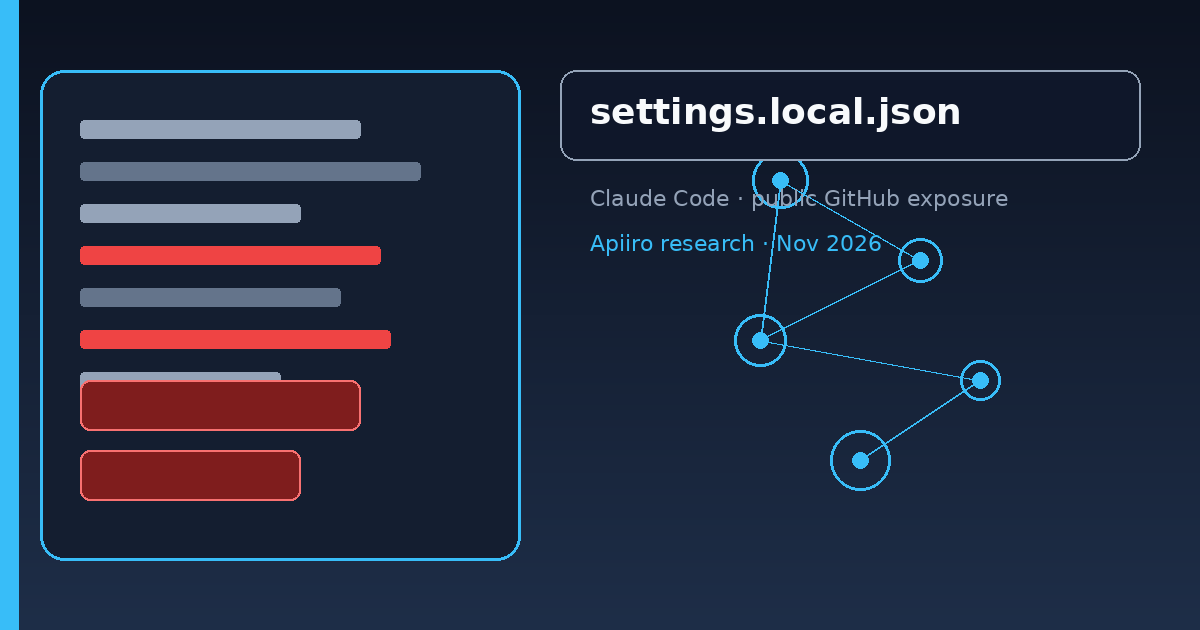
    Takeaway: Apiiro researchers Shmulik Cohen and Matan Giladi report that Anthropic’s Claude Code can store the full text of an approved shell command — including passwords and API keys — in .claude/settings.local.json when a developer chooses “Yes, and don’t ask again.” Their public-GitHub scan found 104,185 copies of that file across 103,617 repositories; about 1.1% (1,122 copies) held at least one secret, totaling 1,379 distinct secrets in those files. Counting older git history, shared .claude/settings.json, and agent transcripts, they report 2,539 secrets across 1,994 repositories. Apiiro did not verify that credentials still work; one notified company confirmed a key had been live. Primary coverage: The Hacker News (Swati Khandelwal, Nov 7, 2026) and iTWire’s summary of the Nov 5 research.

    This is a developer-security story about an ordinary approval workflow — not a claim that Claude Code is deliberately exfiltrating secrets, and not a rehash of product launches like Claude Personal Finance, Anthropic message threads, or this week’s GPT-6 Cyber / Cursor Build Live Apps coverage.

    How a secret lands in settings.local.json

    By default, Claude Code asks before running most shell commands. If the user picks “Yes, and don’t ask again,” the tool saves an allow rule in the project’s .claude/settings.local.json, as described in Anthropic’s permissions documentation (summarized by THN/iTWire). Matching commands can then run without another prompt in later sessions.

    The saved rule covers only what the prompt offered. Sometimes that is a pattern (for example npm test *). Sometimes it is one exact command. When the exact command includes a password, token, or key typed on the command line, that secret is stored in plain text inside the JSON file.

    Apiiro says it reproduced the behavior with the latest models available to them (THN names Opus 5.5 and Fable 5.1). The leak path is the approval record itself: a credential used to do legitimate work becomes part of the permission that authorizes the same work next time.

    What Anthropic’s git protection does — and does not do

    Claude Code tries to keep the local settings file out of git. According to its settings documentation (as reported by THN), the first time it writes the file inside a git repository, it adds the path to the user’s global git excludes. Git on that machine then ignores the file in every repository.

    • What that helps: a single developer’s machine can stop newly written local settings from being offered for commit, without editing every project’s .gitignore.
    • What it does not do: the exclude lives in that user’s git config on that computer. It does not travel with the project the way a committed repository .gitignore does.
    • Already-tracked files: ignore rules do not untrack files already under version control. If .claude/settings.local.json was committed earlier, global excludes will not remove it from the repo or from history.
    • No project .gitignore by default: researchers say Claude Code does not add the file to the project’s own .gitignore, so teammates and CI on other machines do not inherit the protection.

    In 539 of 1,105 repositories Apiiro traced that contained secrets, a commit listing Claude as a co-author changed the settings file — evidence, in the researchers’ reading, that Claude often participates in committing the file, not that every secret was introduced by the agent.

    Apiiro’s key numbers

    MetricFigureNotes
    Public copies of .claude/settings.local.json104,185Across 103,617 repositories
    Copies with ≥1 secret1,122 (~1.1%)Format/context + AI reviewer; not live-tested
    Distinct secrets in those current files1,379THN / Apiiro
    Broader total (history + shared settings + transcripts)2,539 secrets / 1,994 reposIncludes deleted-file history and forks context
    Database passwords379Largest single category cited
    SSH logins (public servers)43Paired with reachable hosts
    GitHub / GitLab / npm tokens42Developer platform tokens
    AWS keys23Cloud credentials
    Organizations owning exposed files63Mostly software companies of all sizes
    Repos still on default branch (as of research Monday)All secret-bearing files checkedHalf present ≥217 days
    Extra secrets only in older history734 across 509 reposUsually after file deletion
    Forks carrying same secrets211 forks of 74 reposHistory/forks keep exposure alive
    Secrets in shared .claude/settings.json298 of 76,011 copiesTeams often commit shared settings on purpose
    Claude co-authored commits touching file539 of 1,105 traced reposAmong secret-bearing repos traced
    Missed by both gitleaks and TruffleHog215 of 1,122Often passwords inside ordinary commands

    Collection window cited by iTWire: public GitHub data gathered roughly Nov 1–3, 2026. Research write-up dated around Nov 5; THN’s English wrap-up ran Nov 7. Strongest cases Apiiro highlights (without publishing the secrets) include an admin-level cloud key at a database vendor and an owner password for a medical-records database — treat those as researcher examples of severity, not as confirmed breaches of those systems.

    Why scanners miss many of these secrets

    Apiiro ran gitleaks and TruffleHog over every copy without the tools’ verification step. Of the 1,122 files with a classified secret, gitleaks flagged 564 and TruffleHog 643; neither flagged 215. Most misses are passwords typed inside commands — for example after PGPASSWORD=, sshpass -p, or mysql -p — which look like ordinary words on an ordinary command line rather than known key formats.

    That matters for security teams already scanning repos: agent folders such as .claude/, .cursor/, .gemini/, and related memory/transcript paths should be treated more like .env files — on laptops as well as in repositories — and scanners need rules that catch secrets embedded in shell text, not only high-entropy token patterns.

    Claude Code vs other coding agents

    Of 16 coding agents whose documentation the researchers compared, Claude Code is the only one they confirmed saves the full approved command in a project file by default. That is a documentation-and-behavior comparison, not a claim that every other agent is free of secret sprawl — other tools may store approvals differently (user-scoped config, patterns only, redaction, etc.).

    Remediation checklist (rotate first)

    Deleting the current file does not undo a leak: older commits, forks, and clones still hold prior versions. GitHub’s usual guidance — and Apiiro’s — is to rotate credentials before cleanup theater.

    1. 1. Search: Scan your GitHub organization for .claude/settings.local.json and .claude/settings.json, and check each repository’s git history even where the files are gone.
    2. 2. Rotate: Change every password, token, and key those files have ever held. Prioritize credentials paired with a public server address.
    3. 3. Untrack: git rm --cached .claude/settings.local.json, then add the path to the repository’s own .gitignore (and org templates).
    4. 4. Scrub local rules: Open the file on each developer machine — even if it was never committed — and delete every allow rule that contains a secret.
    5. 5. Prefer env vars / secret managers: Refer to secrets as variables (for example $DB_URL) so a saved rule stores the variable name, not the literal. Putting the password in an inline ENV=secret cmd still places the secret in the command text.
    6. 6. Approve patterns, not one-off commands: Prefer pattern approvals such as Bash(npm run:*) instead of a single exact command that embeds credentials.
    7. 7. Widen the blast-radius check: Look for the same JSON inside npm packages, Docker images, zip archives, and synced folders — copies that never hit GitHub still matter on developer machines (Apiiro notes malware such as the September 2025 Shai-Hulud worm already ran TruffleHog-style scans on infected machines).

    Earlier reports and Anthropic’s response so far

    Users flagged the same behavior before Apiiro’s count. THN cites a bug report filed August 11, 2025 stating that approved commands with API keys and tokens were stored word-for-word in settings.local.json. An automated bot closed that report as “not planned” on January 3 after 60 days without activity. As of THN’s Nov 7 article, the four related reports researchers cite had all been closed by the same bot — the most recent the day before — with no Anthropic reply visible in those threads.

    iTWire also notes a February 2026 write-up from security firm ironPeak describing a committed Claude settings file that contained approved commands with database passwords and API keys, plus a tool aimed at finding secrets in AI configuration files and their history. Those earlier reports support the mechanism; they do not independently re-count Apiiro’s 2026 repository totals.

    What this is — and what it is not

    ClaimStatusCaveat
    Exact approved commands can be saved in .claude/settings.local.jsonConfirmed by docs + research reproductionOrdinary “don’t ask again” workflow
    1,122 public copies with ≥1 secret; 1,379 distinct in those filesApiiro findingClassification, not live auth tests
    Broader 2,539 secrets / 1,994 reposApiiro findingIncludes history, shared settings, transcripts
    Global git excludes protect newly written files on that machineDocumented Anthropic behaviorDoes not fix already-committed files or other machines
    Credentials still usable / systems breachedNot established by ApiiroOne notified company confirmed a key had been live
    Only Claude Code among 16 compared saves full command to a project file by defaultApiiro documentation comparisonOther agents may store approvals differently

    FAQ

    What is .claude/settings.local.json?

    A project-local Claude Code settings file. When you approve a Bash command with “Yes, and don’t ask again,” Claude Code can write an allow rule there so matching commands skip the prompt later. If the saved rule is an exact command that contained a secret, the secret is stored in plain text.

    Does Anthropic automatically gitignore the file in every repo?

    No. On first write in a git repo, Claude Code can add the path to the developer’s global git excludes. That is machine-local. Researchers say it does not add the path to the project’s .gitignore, and ignore rules do not protect files already committed.

    How many secrets did Apiiro find?

    In current public copies of the local settings file: 1,122 copies with secrets and 1,379 distinct secrets. Broader scope including history, shared settings, and transcripts: 2,539 secrets across 1,994 repositories. Apiiro did not prove those credentials still authenticate.

    Will deleting the file fix a public leak?

    Not by itself. Rotate every exposed credential first. Then stop tracking the file, add it to the repo .gitignore, scrub local allow rules, and plan history/fork cleanup carefully — deletion of the tip commit leaves older versions and forks intact.

    Why didn’t gitleaks or TruffleHog catch everything?

    Many secrets are ordinary passwords embedded in shell commands rather than high-entropy tokens with known prefixes. Apiiro reports 215 of 1,122 secret-bearing files were flagged by neither scanner in their non-verified run.

    Is this the same as a prompt-injection attack?

    No. Coverage describes an authorized developer workflow: you approve a command; the approval record retains the command text. The risk is accidental publication of that record, not a hostile prompt tricking the model into stealing a password.


    Sources: The Hacker News — Claude Code’s “Don’t Ask Again” file (Swati Khandelwal, Nov 7, 2026); iTWire — Apiiro Claude Code approval files (David M Williams, Nov 7, 2026), attributing research to Apiiro’s Shmulik Cohen and Matan Giladi (Nov 5). Figures above are from that reporting; Apiiro’s own blog post was not independently loaded for this article. We do not claim credentials remain valid unless an affected party confirmed it.

  • OpenAI Images 2.6: Faster Generation + Native GIFs in ChatGPT (2026)

    OpenAI Images 2.6: Faster Generation + Native GIFs in ChatGPT (2026)

    Takeaway: On Nov 4, 2026, OpenAI launched Images 2.6 across ChatGPT, Codex, and the API. Headline features: roughly 50% faster image generation, native GIF creation from text or still uploads (with playback-speed and in-ChatGPT frame edits), and API variants GPT-Image-2.6 Flare (fast; low quality as little as ~6 seconds) and GPT-Image-2.6 Sunburst (higher quality/consistency at medium/high). OpenAI says people now create about 4 billion images per week across ChatGPT, Codex, and the API. Distinct from same-week OpenAI stories like GPT-6 Cyber and ChatGPT Business Hub analytics — this is the image/GIF stack, not cybersecurity models or search-console-style analytics.

    Primary sources: OpenAI’s Introducing Images 2.6 post, the Images 2.6 GIF risks, safeguards, and evaluations system-card page, and The Verge’s Nov 4 report on animated GIFs in ChatGPT.

    What OpenAI shipped

    • Surfaces: Images 2.6 in ChatGPT, Codex, and the API.
    • Speed: generates images ~50% faster than before (OpenAI).
    • GIFs: animate from text prompts or uploaded stills; adjust playback speed; edit frames in ChatGPT. OpenAI Help guidance (cited in product materials / Verge coverage context): you generally cannot edit an already-uploaded animated GIF the same way — generate or edit frames from stills/text instead.
    • Scale claim: ~4 billion images/week across ChatGPT, Codex, and API (~half a billion/day average).
    • Availability: globally today in ChatGPT and Codex across all subscription tiers on desktop, mobile, and web.
    • API models: GPT-Image-2.6 Flare and GPT-Image-2.6 Sunburst (also reflected in the Nov 4 changelog naming).

    API: Flare vs Sunburst and new controls

    For developers, Images 2.6 splits into two GPT-Image-2.6 flavors plus new editing/export knobs:

    • Flare: optimized for speed; with quality set to low, OpenAI says generation can take as little as six seconds. Also improves layout quality for posters, product imagery, and other professional visuals.
    • Sunburst: higher-quality generation and greater consistency across edits when quality is set to medium or high.
    • Image markup: already in ChatGPT; now in the API so teams can pinpoint where to change.
    • SVG exports: designs ready for websites, apps, and print.
    • Complexity parameter: adjusts how much planning the model does; lower settings for quick edits. Quality controls visual detail/fidelity while complexity guides how much goes into the scene.

    OpenAI’s guidance: for most editing tasks, use low complexity for faster edits paired with the image quality your workflow needs; try medium or high complexity for scenes with many elements or constraints. Pricing for Flare/Sunburst is linked from the Images 2.6 post (check OpenAI’s live pricing page — amounts can change).

    GIF use cases OpenAI highlights

    • Animate a brand mascot for a campaign
    • Reactions and memes for social media
    • Animated storyboards to explore character movement before video production
    • Turn a simple sketch into an expressive animated character for videos or games
    • Product / workplace personality experiments (OpenAI cites Town exploring animated characters for work interactions via the API)

    OpenArt CEO Coco Mao is quoted saying GIFs are the “native language of social media” and that GPT-Image-2.6 lets creators speak it from a single prompt. Figma Weave’s Itay Schiff is quoted on speed plus creative control for character/product/brand consistency inside reusable workflows. Treat quotes as vendor/partner commentary.

    Confirmed vs not

    ClaimStatusNotes
    Images 2.6 in ChatGPT, Codex, APIConfirmedOpenAI product post Nov 4, 2026
    ~50% faster image generationConfirmedOpenAI
    Native GIFs from text or still uploadsConfirmedOpenAI + Verge
    Adjust GIF playback speed; edit frames in ChatGPTConfirmedOpenAI
    Edit uploaded animated GIFs end-to-endLimited / not supported as describedHelp-style guidance: uploaded animated GIFs are not the primary edit path
    4B images/week across ChatGPT/Codex/APIConfirmed (OpenAI claim)Company usage metric
    Flare low-quality ~6 secondsConfirmedOpenAI API section
    Sunburst higher quality/consistency at medium/highConfirmedOpenAI
    API markup + SVG + complexity parameterConfirmedOpenAI
    Global all ChatGPT/Codex subscription tiers (desktop/mobile/web)ConfirmedOpenAI
    GIF safety evaluations publishedConfirmeddeploymentsafety.openai.com system card page

    Safety and competitive context

    OpenAI points creators and developers to a dedicated system-card style page on GIF risks, safeguards, and evaluations for Images 2.6. Read that document before shipping customer-facing GIF tools — animated output can raise different misuse and provenance issues than stills.

    Competitive frame: Google’s same-week creator video push (Gemini Omni 1.2 Flash) targets short video; Images 2.6 doubles down on stills-plus-GIF loops inside ChatGPT/Codex/API. Agent and IDE news this week — Perplexity Teammates, Cursor Build Live Apps, Meta’s Muse Spaces — is adjacent AI coverage, not an Images 2.6 rehash. Inside OpenAI’s own stack, GPT-6 Cyber is a cybersecurity model launch and Business Hub analytics is business-search visibility — different buyer problems from faster image iteration and native GIFs.

    Practical checklist

    1. ChatGPT / Codex users: Try GIF from a still you already like, then adjust playback speed before regenerating from scratch.
    2. Frame edits: Prefer generate-then-edit-frames over expecting full edit of an uploaded animated GIF.
    3. API teams: Start with Flare + low quality for iteration; switch to Sunburst medium/high when character/product consistency matters.
    4. Editors: Use low complexity for simple local edits; raise complexity for multi-element constrained scenes.
    5. Design handoff: SVG export is the new bridge from generation into web/app/print pipelines.
    6. Safety: Review OpenAI’s GIF safeguards/evaluations page before enabling animated output in consumer products.

    FAQ

    What is OpenAI Images 2.6?

    Images 2.6 is OpenAI’s Nov 4, 2026 image-generation update for ChatGPT, Codex, and the API. OpenAI highlights ~50% faster generation, native GIF creation, and API models GPT-Image-2.6 Flare and Sunburst with markup, SVG export, and a complexity parameter.

    Can ChatGPT make animated GIFs now?

    Yes. OpenAI says you can bring motion to images with GIFs — from text prompts or by animating an uploaded still — and adjust playback speed. You can edit frames in ChatGPT. Uploaded animated GIFs are not presented as a full edit-in-place path in Help-style guidance.

    What is the difference between Flare and Sunburst?

    Both are GPT-Image-2.6 API variants. Flare is the fast path (as little as ~6 seconds at low quality) and also improves layout for posters/product visuals. Sunburst targets higher quality and greater consistency across edits when quality is medium or high.

    Where is Images 2.6 available?

    OpenAI says Images 2.6 is available globally in ChatGPT and Codex across all subscription tiers on desktop, mobile, and web. Flare and Sunburst are available in the API; see OpenAI’s pricing page linked from the announcement for current rates.

    How does this relate to GPT-6 Cyber or ChatGPT Business Hub?

    They are separate OpenAI product tracks. GPT-6 Cyber is a cybersecurity-focused model launch; Business Hub analytics covers impressions/clicks-style visibility for verified businesses. Images 2.6 is the generative image and GIF stack for creators and API developers.

  • Meta Muse Spaces: Customize the App With AI Experiences (2026)

    Meta Muse Spaces: Customize the App With AI Experiences (2026)

    Takeaway: On Nov 6, 2026, Meta introduced Spaces inside the Muse app — custom, interactive experiences you build by describing an idea (gift tracker, school dashboard, trip planner, and more). You can place spaces in the sidebar or main tabs, hide them, and schedule when they appear. The same day, Meta rolled out specialized Muse / Meta AI models trained with Muse Wonder learnings, bringing Active Memory (2.4× less forgetting; Active Memory eval 90% vs 76%) and Active Focus (67% improvement on everyday tasks with unexpected issues). This is distinct from yesterday’s Muse Realtime Voice / Avatar rollout — Spaces is app customization and memory/focus models, not voice or expressive video.

    Primary sources: Meta’s Design the Muse App, Just for You Newsroom post, Meta AI Research’s Bringing Specialized Models to Muse and Meta AI, plus The Verge and TechCrunch coverage from Nov 6.

    What Meta shipped

    Meta frames Spaces as an interactive way to build a more personalized Muse. You describe an idea; Muse builds a custom experience that becomes part of the app. As you use a space, you can keep adjusting it — add what’s missing, try a new look, or change how it works.

    • Product: Spaces — custom experiences inside Muse, built from a natural-language idea.
    • Placement: sidebar, main tabs, hide when unused, or schedule appearance (e.g. weekly planner on weekdays, weekend plans on Saturday).
    • Live updates: connect apps so spaces refresh in the background (concert dates, price changes, savings progress).
    • In-space actions: check things off, add notes, and edit without leaving the space.
    • Availability: starting Nov 6, Spaces are available everywhere Muse is available.
    • Roadmap: Meta is exploring ways to share spaces with others for more collaborative Muse use.

    Example spaces Meta highlights

    • Shopping hub (holiday/birthday ideas, Instagram saves, Marketplace listings and buyer messages)
    • School dashboard that finds kid-relevant events in school emails and adds them to calendar
    • Music tracker for artists you follow (new releases, upcoming shows)
    • Wedding planner (RSVP list, vendor invoices, to-dos)
    • Trivia game on movies, music, or sports
    • Podcast studio (episode ideas, research, scripts)
    • Order tracker for a small business (orders, customer messages, what needs to ship)
    • Client hub for freelance work (projects, deadlines, invoices)
    • Trip planner (flights, hotel, reservations, day-by-day itinerary)

    Meta also notes half-finished notes-app ideas, messy spreadsheets, or hobbies you want to dive into are fair game for a space.

    Active Memory and Active Focus (same-day model update)

    Alongside Spaces, Meta says it is rolling out specialized versions of its existing models to Muse and Meta AI, trained using learnings from the Muse Wonder series. The research post focuses on two capabilities first introduced with Muse Wonder:

    • Active Memory: remember what matters and recognize when earlier information becomes relevant. Meta reports a 2.4× reduction in forgetting critical information needed for goals, and an Active Memory eval of 90% tasks correctly using critical context for the current Muse model vs 76% previously.
    • Active Focus: keep working toward a goal when unexpected challenges appear. Meta reports a 67% improvement completing everyday tasks where issues arise.
    • Personal Superintelligence Index: Meta also publishes current Muse at 47% vs previous 38% on that internal index — treat as Meta’s own benchmark, not an independent audit.

    Meta says the specialized models also lean into multi-tasking (when to push independently vs collaborate live) and adapting to mid-task steers without getting confused. In Meta AI, the same improvements are positioned as a sharper thinking partner.

    Confirmed vs not

    ClaimStatusNotes
    Spaces available everywhere Muse is available (from Nov 6)ConfirmedMeta Newsroom
    Describe idea → Muse builds space; iterate afterwardConfirmedNewsroom + Verge
    Sidebar / main tabs / hide / schedule appearanceConfirmedNewsroom example: weekday planner vs Saturday weekend plans
    Connect apps → background updatesConfirmedConcert dates, prices, savings cited
    Check off / notes / in-space editsConfirmedNewsroom
    Sharing spaces with othersExploringNot shipped in this announcement
    Active Memory 2.4× less forgetting; 90% vs 76% evalConfirmed (Meta research)Company evals
    Active Focus 67% improvement on disrupted everyday tasksConfirmed (Meta research)Company evals
    ~10M Muse users US/CanadaPress / earnings citeTechCrunch: Zuckerberg on Oct earnings; not in Spaces Newsroom post
    Same feature as Realtime Voice / AvatarNoSeparate Nov 5 voice/avatar vs Nov 6 Spaces + models

    Why it matters

    Spaces pushes Muse from a chat-and-avatar companion toward a customizable shell — closer to mini-apps you live in than one-off prompts. That sits next to, not on top of, Meta’s other November Muse news: Realtime Voice and expressive avatars (Nov 5) are about presence and interruptible talk; Spaces (Nov 6) is about organizing the app around routines and goals. Active Memory / Focus try to make those long-running spaces less amnesiac when context returns.

    Competitive frame for readers: always-on agent desks like Perplexity Teammates emphasize persistent coworkers for ongoing work; OpenAI’s consumer stack this week includes ChatGPT Business Hub analytics and image tooling (separate post). Publisher-side Meta news — pausing Commercial Terms scrape updates — remains a different track from Muse product UX. Same-week model launches such as GPT-6 Cyber and creator video like Gemini Omni 1.2 Flash are adjacent AI headlines, not Muse Spaces duplicates.

    TechCrunch notes Zuckerberg posted that he had built a BBQ game, event tracker, and home control dashboard with Spaces, and cites his October earnings comment that Muse agents had about 10 million users in the U.S. and Canada less than two months after debut. Treat the user figure as a press/earnings citation, not a Spaces Newsroom claim.

    Practical checklist

    1. Muse users: Try one practical space (trip planner or order tracker) before a playful trivia/game space so you learn placement and scheduling.
    2. App connections: Only connect accounts you are comfortable letting Muse refresh in the background — calendar and shopping data will surface without a fresh prompt.
    3. Routine design: Use scheduled appearance for work vs weekend spaces so the main tabs stay uncluttered.
    4. Do not confuse with Realtime Voice: Voice/avatar is a conversation surface; Spaces is a custom experience surface inside the same app.
    5. Sharing: Collaboration/sharing of spaces is still “exploring” — plan for personal use until Meta ships share controls.
    6. Eval caution: Active Memory / Focus and Personal Superintelligence Index numbers are Meta’s own evaluations.

    FAQ

    What are Muse Spaces?

    Spaces are custom experiences you create inside the Muse app by describing an idea. Meta’s examples include gift trackers, school dashboards, music trackers, wedding planners, trivia games, podcast studios, order trackers, client hubs, and trip planners. Each space becomes part of Muse so you can keep it where you want and return later.

    Can I control where Spaces appear in the Muse app?

    Yes. Meta says you can add spaces to the sidebar, move them into main tabs, hide ones you do not need, and schedule when they appear — for example a weekly planner during the workweek and weekend plans on Saturday.

    Do Spaces update automatically?

    If you connect the apps you use, Meta says spaces keep themselves up to date in the background (new concert dates, price changes, savings progress) without you having to ask. You can also check items off, add notes, and edit inside the space.

    When did Spaces launch, and can I share them?

    Meta’s Nov 6, 2026 Newsroom post says Spaces are available everywhere Muse is available starting that day. Sharing spaces with others is something Meta says it is exploring, not a confirmed ship in the announcement.

    How is this different from Muse Realtime Voice and Avatar?

    Realtime Voice/Avatar (announced Nov 5) lets you talk to Muse with interruptible speech and an expressive avatar. Spaces (Nov 6) lets you design custom app experiences and, the same day, Meta rolled specialized models with Active Memory and Active Focus into Muse and Meta AI. Same Muse product family; different surfaces.

  • Perplexity Teammates: Always-On AI Agents for Work (2026)

    Perplexity Teammates: Always-On AI Agents for Work (2026)

    Takeaway: Perplexity launched Teammates on Nov 5, 2026 — always-on personal AI agents that own complex, ongoing work instead of one-shot chat sessions. They build on Perplexity Computer, collaborate across jobs that can run simultaneously, surface progress in per-agent threads (and Slack), and currently require Perplexity Max (~$200/month). Primary framing comes from CEO Aravind Srinivas on X and Perplexity’s product pages; The Verge (Emma Roth) positions the launch against OpenAI’s Dots and Claude Duet, noting Max is more expensive than some rivals’ agent tiers.

    Official docs: Teammates blog post, Help Center, product hub, and changelog. Perplexity’s site is often bot-gated; we verified product claims against Verge, Digital Trends, and Srinivas’s launch thread rather than inventing UI details.

    What Teammates are (vs Computer)

    Srinivas’s launch post frames the shift clearly: from writing prompts in a session to giving high-level goals. Teammates are rolling out first to Max users on the web, with native mobile/desktop apps “coming soon.”

    The important product move is persistence. Computer ran ephemeral sandbox / workspace jobs. A Teammate is positioned as a persistent coworker you can delegate responsibilities to end-to-end — bootstrapped from Projects, Memory, Skills, connectors, files, and past sessions already inside Perplexity and Computer (per Srinivas’s thread and Digital Trends’s read of the launch).

    • Own ongoing work: plan/coordinate tasks, monitor connected tools, follow through until results are ready for human review (Perplexity product framing; Verge).
    • Parallel roles: assign different jobs that can run at the same time — Verge’s explicit comparison point to OpenAI Dots and Claude Duet.
    • Progress surfaces: individual threads in the Perplexity app; Slack interaction for channel-aware / specialized roles.
    • Learning loop: Teammates are described as improving from feedback so repeated corrections stick (Srinivas).

    How you interact with them

    Verge notes each Teammate gets its own thread so you can watch progress without stuffing every role into one chat. Srinivas adds Slack: Teammates can watch ongoing work in a channel and act when something changes. Digital Trends (citing the launch) also says each runs in its own environment — you can review work, take over its desktop, or redirect it. Treat “isolated desktops / take over desktop” as launch-demo language from Perplexity’s marketing surface, not a full admin manual.

    Example internal workloads Srinivas listed as already daily at Perplexity: automated bug triage, QA loops, security monitoring, data analysis, managing A/B tests in production, and growth marketing. Those are company examples — not a guarantee every Max subscriber’s connectors can do the same on day one.

    Pricing: Max-only (~$200/month)

    Access is gated to Perplexity Max. Verge calls out that Perplexity’s take is more expensive than some rivals’ agent tiers at roughly $200 / month. Digital Trends likewise says free and Pro users must upgrade to Max. For buyers, the comparison is not “another chat model” — it is whether always-on multi-agent orchestration is worth a Max seat versus cheaper agent add-ons elsewhere.

    DimensionPerplexity Teammates (reported)OpenAI Dots / Claude Duet (Verge framing)
    Core pitchAlways-on agents for ongoing workArray of tasks while running 24/7 (Verge)
    Base substrateBuilds on Perplexity ComputerRival agent stacks
    CollaborationMultiple Teammates / parallel jobsSimilar multi-role positioning (Verge)
    Progress UIPer-Teammate threads + SlackProduct-specific (not detailed here)
    Entry priceRequires Max ~$200/mo (Verge/DT)Verge: some rival agent tiers cheaper
    RolloutMax web first; native apps soon (CEO)Separate launch timelines

    Competitive context: Dots, Duet, and the agent desk race

    Emma Roth at The Verge explicitly groups Teammates with OpenAI’s Dots and Claude Duet — always-on agents that can perform an array of tasks. That is the useful buyer frame: 2026’s fight is less “who has the best single-turn model” and more “who can keep specialized agents alive across tools, memory, and review loops.”

    Adjacent agent stories on this site for context: Cursor’s Build Live Apps cloud-agent path, Meta’s Conductor multi-agent coding acquisition, Vercel agent-desktop computer use, Anthropic message threads for Claude agents, ChatGPT Chat/Work tab merge, and DeepSeek’s open-source Super Agent. Teammates sit closer to persistent workspace coworkers than to one-shot coding sandboxes.

    What Perplexity claims internally (label as company metrics)

    Srinivas posted company-side adoption numbers after launch — treat these as Perplexity-reported internal metrics, not third-party audits:

    • About 10,000 teammates in Perplexity’s internal workspace in the last 30 days — “already 20x our headcount,” with ~1,000 active the prior day (Nov 5 post).
    • Median employee now gets 7× more agent-hours per week from teammates than in September; 1 in 5 already at 40+ agent-hours/week (Nov 6 post).
    • Vision line (also cited by Verge): over time, every org with hundreds of teammates per person (thread reply).

    Those figures are useful as demand signal and product intent. They do not prove Max ROI for an outside team with messy connectors and weak human review habits.

    Buyer checklist before you pay for Max

    1. Map the jobs: pick 2–3 ongoing workflows (triage, research digest, QA) that benefit from persistence — not one-off prompts.
    2. Inventory connectors: Teammates bootstrap from existing Projects/Memory/Skills/files; thin context = thin agents.
    3. Decide the review loop: threads + Slack only help if someone owns approvals when an agent proposes spend, emails, or code changes.
    4. Price-check rivals: Verge’s point stands — Max is a premium seat; compare against cheaper agent tiers if you only need occasional automation.
    5. Security posture: always-on agents with tool access amplify blast radius; start with read-mostly roles and escalate privileges after a clean week of reviews.
    6. Native apps lag: web-first Max rollout; do not plan mobile-primary ops until apps ship.

    What this means for SEO / GEO teams

    Teammates are not a search ranking product — but they matter for content ops and AI-visibility workflows. A Max seat that watches Slack, digests competitor moves, and drafts briefings can compress the “always-on research” layer that GEO teams currently stitch from chat sessions and human PMs. Pair that with measurement discipline (your own analytics, Search Console, and any future ChatGPT-side brand charts) rather than assuming agents will invent strategy.

    Publishers and agencies should also watch naming collisions: Perplexity Computer (task sandboxes), Teammates (persistent roles), and Max (billing gate) are three different product nouns. Clear internal docs prevent teams from buying Max for a Computer-only need — or under-buying when they actually want always-on Slack agents.

    Open questions (do not invent answers)

    • Exact Max entitlements / concurrency limits per seat (not fully specified in Verge/DT summaries).
    • Enterprise admin controls, SSO, and audit logs beyond individual Max.
    • How Teammate “desktop takeover” maps to Fully Local Computer on Mac (see changelog title) for regulated environments.
    • Whether Pro will ever get a lighter Teammate tier, or Max remains the only door.
    • How Teammates relate commercially to OpenAI Dots / Claude Duet feature-for-feature once all three publish full docs.

    FAQ

    What are Perplexity Teammates?

    Always-on personal AI agents from Perplexity designed for complex, ongoing work: they plan and coordinate tasks, monitor connected tools, and follow through until results are ready for review. They build on Perplexity Computer and can run multiple assigned jobs in parallel.

    Do Perplexity Teammates require Max?

    Yes, according to The Verge and Digital Trends coverage of the Nov 5, 2026 launch. Teammates require Perplexity Max (about $200/month). Free and Pro users need to upgrade. Verge notes this is more expensive than some rivals’ agent tiers.

    How is this different from Perplexity Computer?

    Computer is described as ephemeral sandbox/session work. Teammates are positioned as persistent coworkers that keep context from Projects, Memory, Skills, connectors, and past sessions, and keep working across ongoing responsibilities.

    How do you monitor a Teammate?

    Progress appears in individual threads inside the Perplexity app. You can also interact with Teammates in Slack, where they can watch a channel and act when something changes (per CEO Aravind Srinivas and Verge).

    How does Perplexity compare Teammates to OpenAI and Anthropic?

    The Verge groups Teammates with OpenAI’s Dots and Claude Duet as always-on work agents. Srinivas’s broader vision is organizations with hundreds of teammates per person. Feature parity details should be checked against each vendor’s own docs as they evolve.

  • ChatGPT Business Hub Analytics: Search Console-Style Mentions & Clicks (2026)

    ChatGPT Business Hub Analytics: Search Console-Style Mentions & Clicks (2026)

    Takeaway: OpenAI is reportedly building a ChatGPT Business Hub analytics surface for verified businesses — daily charts of impressions (how often the business appears in ChatGPT answers) and clicks to the site, plus ways to claim the business, update products/info, and let a business agent answer with controlled context. The feature was spotted by Marketplace Pulse founder Juozas Kaziukėnas and reported Nov 6, 2026 by Search Engine Land, Search Engine Roundtable, and PPC Land. OpenAI has not officially announced it. Treat details as work-in-progress UI, not GA product docs.

    Why it matters for GEO/AEO: first-party mention + click charts would be the closest thing ChatGPT has offered ordinary brands to a “Search Console for ChatGPT” — with a hard limit: no prompts, no user data, no competitor rankings. Pair it with third-party prompt trackers if it ships.

    What was spotted (reported, not announced)

    Per Kaziukėnas (as relayed by SEL / SER / PPC Land), a banner inviting businesses to claim their business in ChatGPT outlines three jobs:

    • See how your business shows up: track how often the business is mentioned in ChatGPT conversations.
    • Show customers what you offer: add latest products and keep business info up to date.
    • Help customers make decisions: let a business agent answer questions with context you control.

    On measurement specifically: impressions = times the business appeared in ChatGPT responses; clicks = link clicks to the website; both tracked daily and shown as a chart. Kaziukėnas says he saw early steps as early as August, and that a banner on Nov 6 suggested launch was getting close. Access is described as limited to businesses that verified ownership — example given: connecting a Shopify store. The analytics sit inside a larger Business Hub feature.

    What it explicitly does not show

    • No prompts — you will not see the questions that drove each mention.
    • No user data — privacy-safe for OpenAI; opaque for marketers who want query intent.
    • No competitor rankings / benchmarks — you get your curve, not share-of-answer vs rivals.

    Kaziukėnas’s framing (quoted across the three outlets): the charts alone cannot explain why mentions/clicks move, but combined with external tools that track prompts they can validate whether GEO/AEO work is working against accurate first-party outcomes. Search Engine Roundtable notes the surface appears aimed at organic ChatGPT answers and seems separate from ChatGPT ads.

    Search Console comparisons (useful, imperfect)

    Barry Schwartz likened the project to Search Console / Webmaster Tools for ChatGPT. PPC Land maps the report against Glenn Gabe’s July 2025 “Case for ASC” wishlist and Google/Bing’s partial AI reporting:

    CapabilityReported ChatGPT Business HubGoogle generative AI reports (2026)Bing AI Performance
    Impressions / appearancesDaily mention impressions (reported)AI impressions by page/country/device (no queries)Citations + grounding queries (sampled)
    ClicksWebsite click charts (reported)Not in generative AI reports (as of Aug 2026 coverage)Not the same as ChatGPT click-outs
    Prompts / queriesExcluded (reported)Not providedSampled grounding queries
    Competitive viewExcluded (reported)LimitedTopics Portfolio beta (rivals cited)
    Verification pathe.g. Shopify connect (reported)Search Console propertyBing Webmaster Tools

    Bottom line from the reporting: if Business Hub ships as described, ChatGPT would join Google and Bing in offering partial AI visibility data — mentions + clicks without the prompt layer most GEO teams still need.

    Confirmed vs rumor — label the uncertainty

    ClaimStatusNotes
    UI / banner for claim-business + analytics spottedReportedKaziukėnas LinkedIn; SEL/SER/PPC Land Nov 6
    Daily impressions + clicks chartsReportedSame sources
    Part of Business Hub; verified businesses onlyReportedShopify given as verification example
    Work-in-progress since ~August 2026ReportedKaziukėnas
    Launch imminentSuggested by banner onlyNot an OpenAI ship date
    Official OpenAI product announcementNot happenedDo not cite as GA
    Shows prompts or competitor ranksExplicitly not (per spotter)Pair with third-party GEO tools
    Same as ChatGPT Business workplace planDifferent namingSER/PPC Land warn of name collision
    Same as ChatGPT ads reportingReportedly separateOrganic answers focus

    How GEO / SEO teams should prepare

    ChatGPT’s search-like query volume is already a planning input for many brands — we covered OpenAI’s ~one-fifth of Google volume framing earlier. First-party charts would change the measurement stack more than the content stack:

    1. Verify early: if Shopify (or other) ownership connect becomes the gate, ecommerce brands should map who owns that connection before launch week.
    2. Keep third-party prompt panels: Business Hub will not replace tools that sample prompts across ChatGPT / Perplexity / Gemini — it complements them.
    3. Define “impression” internally: text mention vs product card vs citation may differ; wait for OpenAI docs before rewriting OKRs.
    4. Content still wins mentions: clear entity pages, product feeds, and answer-shaped content (see useful ChatGPT prompts for SEO) matter more once you can see the curve.
    5. Publisher caution: mention charts help brands; publishers fighting unpaid AI reuse still need licensing and policy tracks (cf. EU press-publisher AI fights and Google AI contribution / generative controls).

    Ads, agents, and naming collisions

    Do not confuse surfaces: ChatGPT Business (workplace subscription), ChatGPT ads (paid placements with existing Ads Manager reporting), and the spotted Business Hub (organic visibility + claim/update/agent) are different stories in the reporting. PPC Land also notes OpenAI’s commerce/Shopify rails and Sponsored Agents tests — whether the organic “business agent” ties to paid Sponsored Agents is not established.

    Practical checklist while you wait for an official launch

    1. Watch OpenAI Help / business surfaces for a real announcement; until then cite SEL/SER/PPC Land as secondary reporting.
    2. Baseline GEO now with third-party mention tools so you have a before/after when first-party charts appear.
    3. Instrument site analytics for chatgpt.com / chat.openai.com referrers — Hub clicks will only cover direct click-outs, not “read in ChatGPT then Google the brand.”
    4. Entity hygiene: NAP consistency, product schema, and Shopify catalog accuracy if that is your verification path.
    5. Separate OKRs: paid ChatGPT ads CTR ≠ organic mention impressions.
    6. Publishers: ask whether verification paths exist beyond Shopify; nothing in the reports confirms a publisher-specific claim flow.

    Why first-party data changes GEO budgets

    Third-party GEO panels estimate visibility by probing prompts. Useful — and fragile when platforms change access (PPC Land notes Semrush dropping Copilot tracking around Nov 9, 2026). A first-party OpenAI chart would not replace those probes, but it would give finance and SEO leads a number they can defend in budget reviews: “ChatGPT mentioned us N times and drove M clicks last week.” That matters as ChatGPT’s search-like volume grows while referral share for many sites stays small.

    Also remember attribution gaps: users who see a brand in ChatGPT and later search Google may never appear as a ChatGPT click. Hub click charts would firm up the direct slice only. Keep Search Console and brand-search trends in the same dashboard.

    Publisher vs brand angles

    Brands with Shopify catalogs fit the reported verification example cleanly. Publishers and B2B SaaS without a store need to watch whether OpenAI adds domain DNS, Search Console-style HTML tags, or partner portals. Until that is documented, treat Shopify as an existence proof of verification — not the only possible path — and do not assume newsrooms can claim a “Business Hub” the same way merchants can.


    FAQ

    Has OpenAI officially launched ChatGPT Business Hub analytics?

    No. As of the Nov 6, 2026 reports from Search Engine Land, Search Engine Roundtable, and PPC Land, the feature was spotted in-product / via screenshots by Juozas Kaziukėnas. OpenAI has not published an official announcement.

    What metrics would Business Hub show?

    According to the spotter, daily impressions (appearances of the business in ChatGPT responses) and clicks to the business website, displayed as charts. It reportedly does not show prompts, user data, or competitor rankings.

    Who can access it?

    Reports say it is part of Business Hub and only available to businesses that verify ownership — with connecting a Shopify store given as an example. Other verification methods have not been detailed.

    Is this the same as ChatGPT ads or ChatGPT Business plans?

    Search Engine Roundtable says the analytics appear separate from ChatGPT ads and aimed at organic answers. “ChatGPT Business” as a workplace subscription is a different product name than the spotted Business Hub for brands that appear in answers.

    Will this replace third-party GEO tools?

    No — and the spotter says so explicitly. Without prompts or competitive benchmarks, first-party charts validate outcomes but do not diagnose query intent. Keep prompt-tracking tools alongside any future OpenAI dashboard.

  • Meta Pauses Commercial Terms Update That Would Expand Scraping Rights (2026)

    Meta Pauses Commercial Terms Update That Would Expand Scraping Rights (2026)

    Takeaway: Meta has indefinitely paused proposed updates to its Meta Commercial Terms, Product Catalog Terms, Self-Serve Ad Terms, and Ad Creative Generative AI Terms. The company says the updates will not take effect on November 20, 2026, and that existing terms remain in effect while it consults stakeholders. The pause follows publisher backlash, preliminary injunctions in Norway and Brazil, a UK Competition and Markets Authority probe, and bipartisan U.S. Senate letters — not a quiet product tweak.

    Reporting: Nieman Lab (Nov 5), Ars Technica (Nov 6), and Reporters Without Borders. Meta’s commercial-terms page remains the official document surface (facebook.com/legal/commercial_terms); Nieman Lab quotes Meta’s Business Help Center pause notice in full.

    What Meta paused — and what it does not mean

    According to Nieman Lab, Meta removed the preview of the proposed terms and published a Business Help Center update stating that the four term sets are “now paused and will not take effect on November 20, 2026,” that Meta is “continuing to consult with stakeholders,” and that “existing terms remain in effect.” A Meta spokesperson told Nieman Lab (and, per Ars Technica citing Reuters, also told Reuters): “We’re pausing the changes as we continue to engage with stakeholders and take our time to get this right.”

    Pause ≠ permanent withdrawal. Meta has not announced that the commercial-scraping language is dead forever. It has delayed implementation before (first target October 30, then November 20) and now parked the update indefinitely pending consultation. Publishers and SEOs should treat this as a live policy fight, not a closed case.

    What the proposed terms would have allowed

    Nieman’s October coverage (recapped in the Nov 5 piece) and Ars Technica’s analysis describe a design that tied Meta Business account access to broad rights over off-platform pages: domains and pages linked from Meta Business accounts — including, critics argued, paywalled material — for advertising and business products. Early drafts used language associated with AI model training (“train”); Meta later removed the word “train” and narrowed stated uses toward advertising and business products, but legal experts and publisher groups said the revised wording still granted sweeping collection rights.

    • No clean opt-out: Ars reports businesses (including news publishers already fighting unwanted AI scraping) had no meaningful way to refuse the crawl rights while keeping a business Facebook page.
    • Paywall concern: Critics said the terms even contemplated credentials so Meta bots could reliably access gated content — a flashpoint for subscription publishers.
    • robots.txt reminder (not a rewrite of the terms): Meta told page owners that crawling practices “remain unchanged” and that content owners can still signal preferences with robots.txt. Ars notes Meta still faced criticism for not putting specific robots.txt-respect language into the revised commercial terms themselves.

    That robots.txt tension sits next to wider crawl-policy fights we have covered for Google and AI training — see Google’s robots.txt / AI-training policy token moves and publisher-side Google AI contribution / generative controls.

    Timeline: from Oct 15 alarm to Nov 5 pause

    DateEventSource
    Oct 15, 2026Nieman Lab first reports commercial terms would allow scraping of news sitesNieman Lab
    Oct 16Meta removes “train”; limits stated use toward ads/business productsNieman Lab
    Oct 23Effective date pushed from Oct 30 → Nov 20Nieman Lab
    Oct 28Oslo District Court preliminary injunction (Norwegian publishers)RSF / Nieman
    Oct 28Andy Stone (Meta VP Comms): consultation; delay if past Nov 20Nieman / Ars
    Oct 30UK CMA opens formal investigation into exploitative termsRSF / Nieman
    Nov 3São Paulo court temporary suspension (ANJ / ANER / ABERT case)RSF
    Nov 5Preview down; Help Center: paused, no Nov 20 effective dateNieman Lab

    Courts, regulators, and political pressure

    RSF summarizes the Norway and Brazil injunctions: Norwegian media companies won a temporary stop on Oct 28; on Nov 3 a São Paulo court barred Meta from collecting/using members’ content without authorization under the disputed provisions, stressed explicit consent before AI training use, and ordered Meta not to retaliate by cutting accounts — with reported daily fines of 1 million Brazilian reais (about €163,000), capped at 100 million reais.

    In the UK, the CMA is examining whether Meta was “abusing a dominant position by imposing exploitative terms on publishers and advertisers” (Nieman Lab / RSF). RSF also notes the European Commission has received a complaint. In the U.S., Sens. Adam Schiff (D-Calif.) and Marsha Blackburn (R-Tenn.) sent letters asking Mark Zuckerberg to withdraw the terms.

    UK News Media Association CEO Theo Bamber’s line — “Does Meta think we can’t read?” — captured why removing “train” failed to calm the room: “develop” any business product still looked like the same AI pipeline risk (Ars Technica).

    The European angle rhymes with press-publisher AI fights we tracked around CJEU / Szpunar-style publisher AI pressure — different jurisdiction and instrument, same core dispute: platforms cannot treat news URLs as free training fuel just because publishers need distribution.

    Confirmed vs reported (label carefully)

    ClaimStatusNotes
    Updates paused; will not take effect Nov 20, 2026ConfirmedMeta Help Center text via Nieman Lab
    Existing commercial terms remain in effectConfirmedSame Help Center notice
    Indefinite pause while consulting stakeholdersConfirmedMeta spokesperson to Nieman Lab / Reuters
    Preview of proposed terms taken downConfirmedNieman Lab
    Norway + Brazil preliminary injunctionsConfirmedRSF; Nieman Lab
    UK CMA formal investigationConfirmedRSF / Nieman Lab
    Schiff + Blackburn letters to ZuckerbergConfirmedNieman Lab / Ars
    Meta permanently cancelled scraping rights foreverNot establishedPause + consultation only
    robots.txt language written into revised commercial termsNot establishedReminder to page owners; Ars: not in revised TOS text

    Why publishers and SEO teams should care

    Almost every serious news brand and many ecommerce/SaaS companies run Meta Business pages. A terms change that bundled page access with rights over linked websites would have compressed licensing leverage — the same structural squeeze publishers feel as AI answer engines grow (ChatGPT search-like volume already in the conversation around ~20% of Google query volume claims). Even with the pause:

    • Ad + catalog stack stays live under old terms — catalogs, self-serve ads, and generative ad creative still operate; only the disputed update is parked.
    • Policy can return after “consultation.” Track Meta Business Help Center and commercial_terms, not just headlines.
    • Courts bought time, not a global ban — injunctions are preliminary and jurisdiction-limited.
    • robots.txt remains necessary but not sufficient — Meta’s reminder helps optics; contract language is what publishers fought.

    Actionable checklist for publishers & SEOs

    1. Document current Meta Business account terms screenshots and effective dates now — baseline for any future update notice.
    2. Keep robots.txt / crawler blocks current for Meta / Facebook crawlers and AI bots; treat Meta’s reminder as a floor, not a guarantee (pair with robots.txt AI-training policy hygiene).
    3. Legal: track Norway/Brazil dockets and CMA — injunctions can be modified; CMA findings may reshape UK/EU leverage.
    4. Do not abandon Meta distribution blindly — the pause preserves the status quo; plan contingency (alternate traffic, email, search, AI citation) rather than panic-exit.
    5. Licensing posture: if you license content to AI firms elsewhere, keep Meta negotiations separate and written — “ads/business products” can still be AI-adjacent.
    6. Internal owners: assign one person to Meta Business Help Center + commercial_terms weekly until Meta issues a final update.

    FAQ

    Did Meta cancel the commercial terms scraping update permanently?

    No. Meta paused the updates indefinitely and said they will not take effect on November 20, 2026 while it consults stakeholders. Existing terms remain in effect. Nieman Lab and Ars Technica describe a delay and consultation, not a permanent withdrawal.

    Which Meta documents were supposed to change on Nov 20?

    Meta’s Business Help Center notice (quoted by Nieman Lab) names four: Meta Commercial Terms, Product Catalog Terms, Self-Serve Ad Terms, and Ad Creative Generative AI Terms.

    Why did courts in Norway and Brazil get involved?

    Publisher groups sued over terms that would have forced a choice between allowing Meta to collect website content (including, critics said, paywalled material) or losing platform access. Oslo District Court issued a preliminary injunction on October 28; a São Paulo court issued a temporary suspension on November 3 (RSF).

    Does Meta’s robots.txt reminder mean publishers are protected?

    Meta reminded page owners that crawling practices remain unchanged and that robots.txt signals still apply. Ars Technica notes critics still wanted that respect written into the commercial terms themselves. Treat robots.txt as necessary hygiene, not a substitute for contract clarity.

    What should SEO and GEO teams do while the pause holds?

    Maintain crawler controls, monitor Meta’s Help Center and commercial_terms page, track CMA and injunction outcomes, and keep alternate discovery channels healthy — including search and AI-answer visibility work covered in our ChatGPT vs Google volume and publisher AI-rights reporting.

  • Cursor Build Live Apps: Cloud Agent to Live URL (2026)

    Cursor Build Live Apps: Cloud Agent to Live URL (2026)

    Takeaway: On Nov 5, 2026, Cursor shipped Build Live Apps: a cloud-agent workflow that scaffolds a web app, optionally provisions Postgres, puts private/team auth behind Cursor SSO, runs security checks, and deploys a shareable live URL. It is available on all paid plans with cloud agents enabled — not locally, and not on free. The pitch closes the familiar vibe-coding gap where writing code got cheap but shipping past localhost stayed hard. Same news week as Meta’s Conductor multi-agent acquisition and OpenAI’s Pierre/Codex git tooling move, but this is a product shipping story, not an M&A one.

    Primary sources: Cursor’s Build Live Apps changelog and Cloud Agent Apps docs, with same-day analysis on DEV Community.

    What Cursor shipped

    Cursor’s changelog states the problem plainly: agents lowered the cost of writing code, but most apps and tools users build never leave localhost. Build Live Apps lets you describe what you want; Cursor handles scaffolding, database setup when needed, auth configuration, hosting, and a publish step that returns a live link after you pick a unique domain.

    • Entry point: kick off a cloud agent and say explicitly that you want to build an app (docs: not supported locally; not an ambient “deploy everything” mode).
    • Scaffold + infra: web app code; optional Postgres; authentication behind Cursor sign-in / SSO for private and team apps; dedicated hosting account isolated per team or individual.
    • Secrets: if the app must reach your systems (e.g. a data warehouse), Cursor asks for the secrets it needs; the agent never sees the secret values. Team admins typically create team secrets in the Apps dashboard.
    • Repos: new or existing repos on Cursor Origin and GitHub; GitLab support is coming soon.
    • Availability: all paid plans with cloud agents enabled.

    How publish and sharing work

    After the agent prepares the app, Cursor shows a preview tray. Publishing is an explicit user action: you choose the app URL (changeable later), Cursor runs security checks, and only then do you get a live link. Nothing goes live before you choose to publish.

    TopicWhat Cursor documentsNotes
    HostingDedicated account per team (or individual plan)Isolated from other teams/users
    DatabasePostgres provisioned when the app needs oneAutomatic when needed
    Private / team authBehind Cursor sign-inShare with people, groups, or whole team
    Public sharingAnyone with the link (individual plans)Disabled by default for Teams/Enterprise; admin can enable
    API access for bots/scriptsCursor API key via x-cursor-app-token headerHeader only — no query param or cookie
    Admin controlsSee all apps/secrets; custom review rules; approve blocked publishes; unpublishAudit log for setting changes

    Security checks and guardrails

    The publish gate is central. Docs describe four deterministic checks that always run before every publish, even if the broader security review is off: block secrets written in app files; block credential files (private keys, service-account keys, auth-token files); never publish .env files; never publish source maps. On top of those, an AI security review reads the app’s files and can block serious issues. Team admins can add custom instructions to the review prompt — they can add rules, but they cannot remove Cursor’s built-in checks.

    Admins can also turn Apps on or off for the team, allow or disallow public apps (disallowing moves existing public apps back to team visibility), allow or disallow API keys opening apps, and approve publishes the review blocked — except for malicious code, hardcoded secrets, or exposed credentials. That design targets the failure mode of a well-meaning teammate shipping an internal tool with a hardcoded credential and a public URL.

    Who this is for (and who it is not)

    Cursor’s own internal examples span sales, operations, legal, finance, and engineering: event registration and desk seating, multimedia customer presentations, training/onboarding, live sales pipeline dashboards, and portals for engineering services. That list reads as internal tooling and microsites — not a replacement for a full production stack with custom networking or a non-Cursor identity system.

    In the wider AI-coding market this week, Meta is folding Conductor’s multi-agent orchestration into its coding stack, OpenAI is bringing Pierre Computer’s git/review surface into Codex and previously pushed Pando as a git backend for monorepo agents, while open models like DeepSeek’s Super Agent coding track compete on agent capability. Build Live Apps is Cursor’s answer on the last mile: not a stronger coding model alone, but agent-owned deploy + auth + DB + share. It is also distinct from today’s consumer AI product posts (e.g. Claude Personal Finance) and from capability-heavy cyber launches like GPT-6 Cyber or research pipelines such as OpenAI’s Linux kernel LPE findings.

    Practical checklist

    1. Plan check: Confirm a paid plan with cloud agents; free plans do not get Apps.
    2. Be explicit: Tell the cloud agent you want to build (or deploy) an app; local agents will not run this path.
    3. Start low-risk: Prefer an internal dashboard, event signup, or status page with real org users and no high-value secrets.
    4. Secrets hygiene: Use team/personal secrets in the Apps dashboard; verify the agent asks for secrets instead of inventing them.
    5. Publish gate test: Deliberately plant a known-bad pattern in a throwaway app and confirm the check blocks publish before you trust the gate.
    6. Admin visibility: Confirm an admin can list apps/secrets and unpublish after the first real deploy.
    7. Git provider: Expect Cursor Origin + GitHub today; plan separately if your org is GitLab-only until that lands.
    8. Ownership: Decide who owns the live app after ship — Cursor automates deploy, not long-term product ownership.

    FAQ

    Is Cursor Build Live Apps available on free plans?

    No. Cursor’s changelog and docs say Apps is available on all paid plans with access to cloud agents. Free plans and local (non-cloud) agents are out of scope for this workflow.

    Does the cloud agent automatically deploy every app I write?

    No. You must kick off a cloud agent and explicitly say you want to build an app. Publishing is a separate, explicit step after preview and security checks. Nothing goes live until checks pass and you choose to publish.

    What database and auth does Cursor set up?

    If the app needs a database, Cursor provisions Postgres automatically. Private and team apps sit behind Cursor sign-in (SSO). Users on individual plans can also share apps publicly without Cursor auth. Public sharing is disabled by default for Teams and Enterprise unless an admin enables it.

    What security checks run before publish?

    Four always-on deterministic checks block secrets in app files, credential files, shipping .env files, and shipping source maps. An AI security review can also block serious issues. Team admins can add custom review rules but cannot remove Cursor’s built-in checks; they can unpublish any app and, with limits, approve blocked publishes.

    Can scripts or Grok Bot call a private Cursor app?

    Yes, via a Cursor API key sent in the x-cursor-app-token HTTP header on every request (header only — no query parameter or cookie). Personal keys open apps their owner can open; team keys open only team apps they are allowed to use. Public apps work with either key as for a normal visitor.