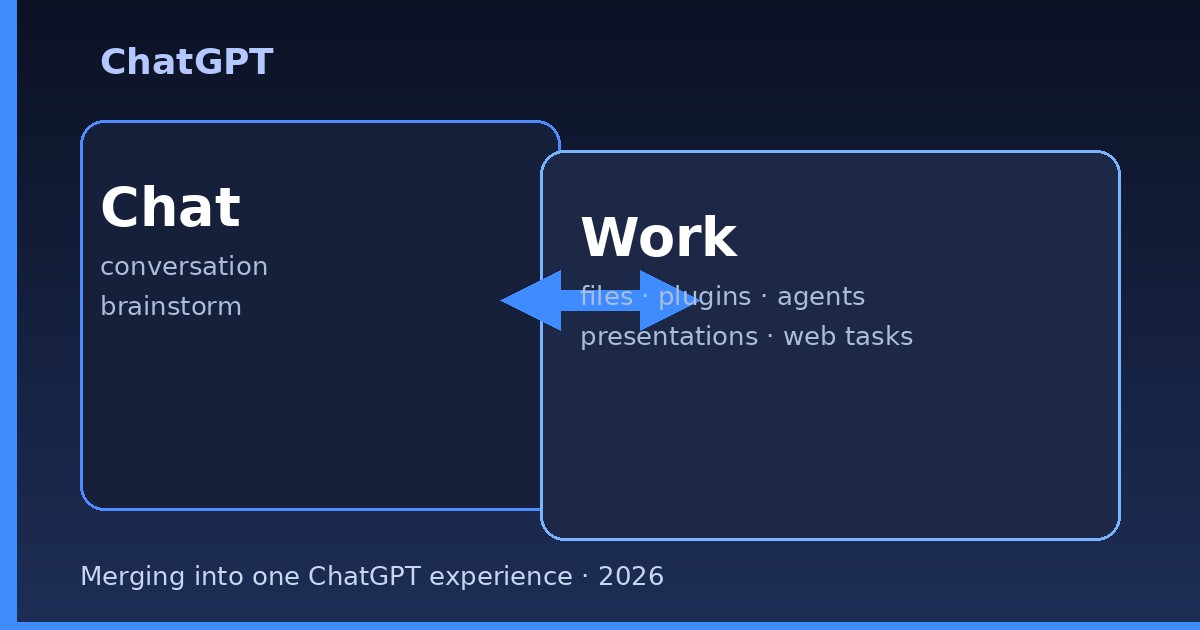
Takeaway: OpenAI is merging ChatGPT’s separate Chat and Work tabs into one ChatGPT experience so you can explore an idea and then have ChatGPT carry the work through — files, plugins, websites, presentations, and guided web tasks — without jumping tabs. The change starts with select users for feedback, then a wider rollout; OpenAI has not announced a wide-release date. Codex stays a separate section in the ChatGPT desktop app. This is a product/UI story, distinct from the December shared ChatGPT + Codex token/usage pool we already covered.
Reporting: TechCrunch (Ivan Mehta, Nov 2, 2026), with corroboration from Digital Trends, The Verge, and Financial News Asia coverage (Nov 3).
Why Chat and Work felt confusing
On the ChatGPT desktop app, users already juggle a high-level split between ChatGPT and Codex. Inside ChatGPT itself, a second split — Chat versus Work — made it easy to lose track of where a project lived. TechCrunch summarized the UX problem plainly: with so many options, it is sometimes easy to forget where you are working and where a project actually sits.
In practice, Chat handled everyday conversation, Q&A, and brainstorming. Work was the lane for heavier, multistep jobs — research, presentations, website builds, and similar deliverables. Switching tabs mid-flow broke context and made “agentic” work feel bolted on rather than continuous.
What OpenAI told users about the merge
According to an email OpenAI sent to users (as reported by TechCrunch), the company is combining Chat and Work within the ChatGPT experience. The merge will first go to select users for feedback before a broader rollout.
Paraphrasing the email’s stated intent: the goal is to let you move from exploring an idea to having ChatGPT carry it through in one place. You can bring in files and plugins and ask ChatGPT to build a website, create a presentation, or do things on the web while you review and guide the work. Codex remains a separate experience in the ChatGPT desktop app.
The Verge noted that OpenAI’s Thibault Sottiaux posted on X that the company is working on this but that it is not rolling out just yet — useful framing if you have not seen the merged UI yet: select-user feedback does not equal a global flip.
Chat vs Work vs merged ChatGPT vs Codex
| Surface | What it is for | What changes with the merge |
|---|---|---|
| Chat (today) | Conversation, Q&A, brainstorming | Folds into one ChatGPT workspace with Work capabilities |
| Work (today) | Heavier tasks: research, decks, sites, multistep jobs | Same capabilities, reachable without a separate tab |
| Merged ChatGPT (incoming) | Idea → execution in one place; files/plugins; guided agentic work | Select users first, then wider; no public wide-release date yet |
| Codex (desktop) | Specialized coding experience | Stays separate in the desktop app — not merged into Chat/Work |
Digital Trends’ framing matches that table: start a conversation, then ask ChatGPT to execute from the same place, keep files and plugins in play, and monitor progress instead of hopping tabs to find the “agent mode.”
Usage limits: shared pool note (not the same story as this UI change)
OpenAI also said that with this transition, ChatGPT and Codex will draw tokens from the same allowance pool. Most users should be unaffected; depending on usage and model, some people may wait for resets more often.
Treat that as a related capacity note, not the headline of this article. We already published a dedicated explainer on the December shared ChatGPT + Codex usage limits for eligible plans. Do not confuse the tab merge with card/device paid-account limits (“Device limit reached”), which gate which paid accounts you can run on a device — a separate control layer.
Why the industry is collapsing chat and agent modes
Anthropic merged Claude’s chat and Cowork into one screen around September 2026 (per TechCrunch). OpenAI’s move follows that pattern: conversation and agentic execution stop being rival “apps” inside the same product.
Financial News’ Asia write-up frames the strategic angle: erasing the boundary between Q&A chat and agent workflows (web tasks, analysis, documents, presentations) is meant to lower the barrier to everyday agent use — assign work inside a normal conversation instead of hunting for a separate agent tab.
That same industry wave shows up outside OpenAI: cloud coding sessions and computer-use surfaces keep pushing agents into the main workflow rather than a side panel. See our recent notes on GitHub Copilot connected cloud sessions and MCP connectors and Vercel Labs agent-desktop accessibility computer use for adjacent product patterns.
What stays the same for power users
- Codex remains separate in the ChatGPT desktop app — coding-focused workflows are not being folded into the Chat/Work merge.
- No announced wide-release date — expect a staged select-user period, then broader availability.
- Guidance and review still matter — OpenAI’s email language emphasizes reviewing and guiding ChatGPT’s work, not fire-and-forget automation.
- Shared token allowance between ChatGPT and Codex is a capacity change that can affect heavy users even when the UI looks cleaner — details in our December shared-pool article.
Publisher and power-user checklist
- If you train teammates on ChatGPT desktop, update screenshots and SOPs: Chat vs Work may disappear for select users first.
- Keep Codex docs separate — coding still lives in its own desktop section.
- Watch usage meters after the transition language around a shared ChatGPT/Codex allowance; heavy agent + coding days may hit resets sooner.
- Do not equate “select users” with GA — Sottiaux’s public note underscores that a full rollout is not live for everyone yet.
- Separate this UI story from account eligibility — card/device limits and “Device limit reached” are covered in our paid account caps explainer.
- For agentic competitor context, skim Copilot cloud sessions and Vercel agent-desktop coverage linked above when comparing how vendors place agents in the primary UI.
FAQ: ChatGPT Chat and Work merge
Is OpenAI deleting Work features?
No. Reporting describes a merge into one ChatGPT experience so Work-style capabilities (files, plugins, building sites, presentations, guided web tasks) sit in the same place as conversation — not a removal of those capabilities.
When does the merged Chat and Work UI ship to everyone?
OpenAI has not announced a wide-release date. The email, as reported by TechCrunch, says select users first for feedback, then a wider rollout. The Verge also cited Thibault Sottiaux saying the company is working on it but it is not rolling out just yet.
Does the merge include Codex?
No. OpenAI’s email states Codex remains a separate experience in the ChatGPT desktop app.
Will this change my ChatGPT usage limits?
OpenAI said that with the transition, ChatGPT and Codex draw from the same token allowance. Most users should not notice; some may wait for resets more often depending on usage and model. For the broader December shared-pool product story, see our dedicated shared usage limits article.
How is this different from Anthropic’s Claude change?
Directionally similar: Anthropic merged Claude chat and Cowork into one screen around September 2026. OpenAI is now combining ChatGPT’s Chat and Work tabs along the same “conversation + agent work in one place” pattern.
Is this the same as ChatGPT device limit reached?
No. Device and card limits control paid-account purchase and device eligibility. The Chat/Work merge is a product UI change. See our Device limit reached explainer if you are hitting account-eligibility warnings.
Bottom line: OpenAI is collapsing ChatGPT’s Chat and Work tabs into one place so brainstorming and agentic execution share a single surface, starting with select users and expanding later — with no public GA date yet and Codex still separate on desktop. Read the capacity angle in our December shared ChatGPT + Codex usage pool post, and keep account-eligibility issues on the separate device-limit track.
Leave a Reply
You must be logged in to post a comment.