Adapted from Paul Vengeons (@VengeonsP) X Article “the only GEO guide you’ll ever need (thank you opus 5.5)”. Original status: https://x.com/VengeonsP/status/2110725609831719227.
THIS IS THE PROCESS A FRENCH AGENCY WITH 400+ CLIENTS RUNS TO GET CITED BY CHATGPT. everyone pays for a tracker and stares at a visibility score –> they cap it at 10 prompts, read what the AI types behind each one, and rank for that. I’m giving you every step and every prompt
TLDR:
- 1. GEO is SEO with one extra map. When ChatGPT doesn’t know, it searches, and it cites what ranks
- 2. Behind every question you ask an assistant, it runs about 10 hidden searches. Those are called fan-outs, and they are your real keywords
- 3. Pick 5 to 10 target questions per site. Never 200. Past 10, the work becomes unmanageable
- 4. Pull the fan-outs once a week, by hand or with a small tool you build yourself. 20 minutes for one site
- 5. Every fan-out gets a pillar: a page on your site, or a place on someone else’s (PR, links, forums, reviews)
- 6. The 5 kinds of pages AIs cite most: comparisons, guides, case studies and reviews, forums, media
- 7. Track a share of voice, not a position. An AI answers with the whole history of the person asking
- 8. Putting yourself first in your own ranking worked for a while. It doesn’t anymore
- 9. Give the AIs one identity: same name, address, phone and listings everywhere
- 10. Be 1st on Google on each fan-out, and the citation follows. Everything else is classic SEO
I’m giving every step and all 10 prompts away for free ✅
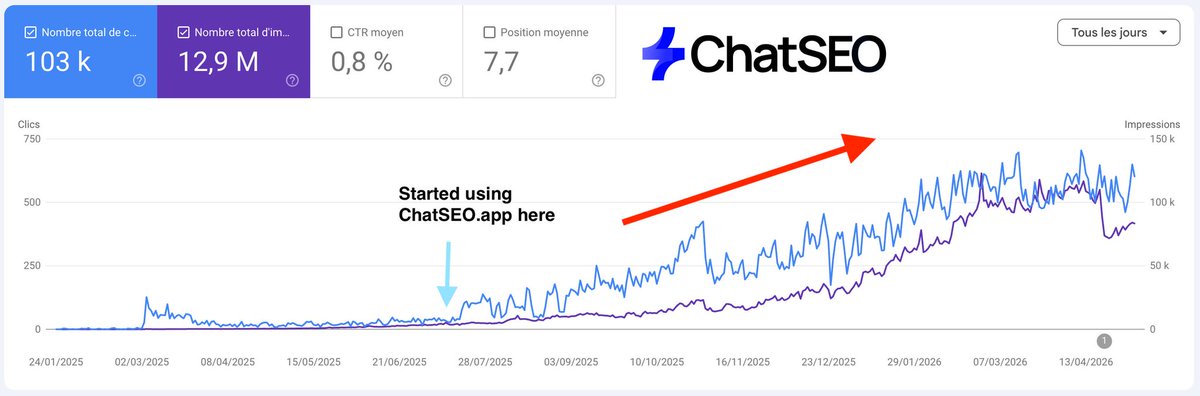
To get similar results for your business: try ChatSEO free for 7 days
This week on MVP, the French SEO podcast I host with Antoine Veyrieres, we did something we rarely do: no guest, just the two of us, and one subject. GEO, the way we actually run it today
Antoine runs SEO Monkey, an SEO agency with more than 400 clients across France. He sees every kind of site, every kind of niche, and every kind of client who walks in asking for “GEO” because they read about it on LinkedIn
The week before we recorded, his agency ran an internal workshop to update its GEO process. One of his team wrote the new standard operating procedure. Antoine brought it to the episode and read it to me, line by line
So this is that process. The agency version, and the version you can run alone on one site with zero budget. Plus my own side of it: what I do differently, what I stopped doing, and the one GEO habit I had for years without knowing it was GEO
We said it on the episode and I’ll say it again here: we already made several GEO videos. Our practices keep moving. This one is the most up to date, with what works now and the mistakes you should not make
The episode is in French. The link is at the end
Last thing: if you want more of these, a like, a quote or a bookmark is what keeps them coming 🙏
Little tip: bookmark this. You’ll come back to it
GEO is SEO with one extra map
Let me start with the sentence that will save you the most money
Antoine said it at the end of the episode, and it’s what he tells every client who asks: SEO and GEO are the same thing. When a client walks in saying “I want GEO”, he says cool, let’s do GEO, it’s called SEO. When a client walks in saying “I want SEO”, he says yes, and you’ll get GEO with it
That’s not a slogan. It’s how the assistants work
When ChatGPT, Claude, Gemini or Perplexity doesn’t know the answer, it searches. It types queries into a search engine, reads what ranks, and quotes it. Google said it itself in its own guide to AI features: the AI answers run on the classic index, through query fan-out
So if you have no SEO, the model has nothing to find. That’s why I never sell GEO as a separate discipline you start after SEO. It sits on top of SEO. Rank first, and the citations come
But there IS one difference, and that’s the whole subject of this article
In classic SEO, you have a target keyword. You rank for it. Job done
In GEO, your target is a question. And behind that question, the AI runs a whole set of searches you never see. You don’t rank for the question. You rank for what the AI searches
-> GEO is not a new discipline. It’s SEO on keywords you didn’t know you had
What a fan-out is (and why it’s your real keyword)
Antoine’s first point, and the one his whole process is built on: map your fan-outs
A fan-out is a sub-search. When you type a question into ChatGPT, it doesn’t search for your question. It breaks it into several smaller searches, runs them, reads the results, and builds its answer from them
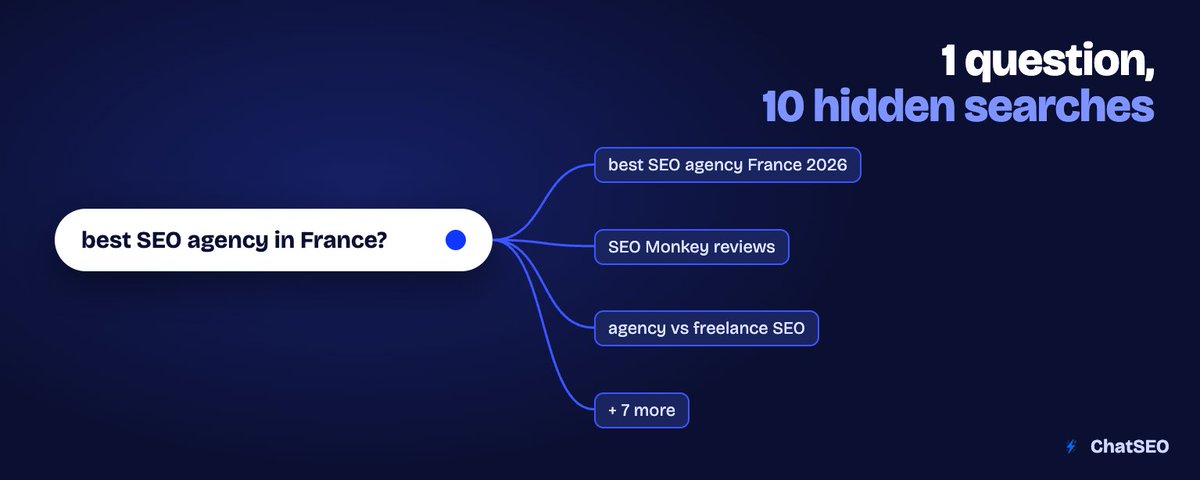
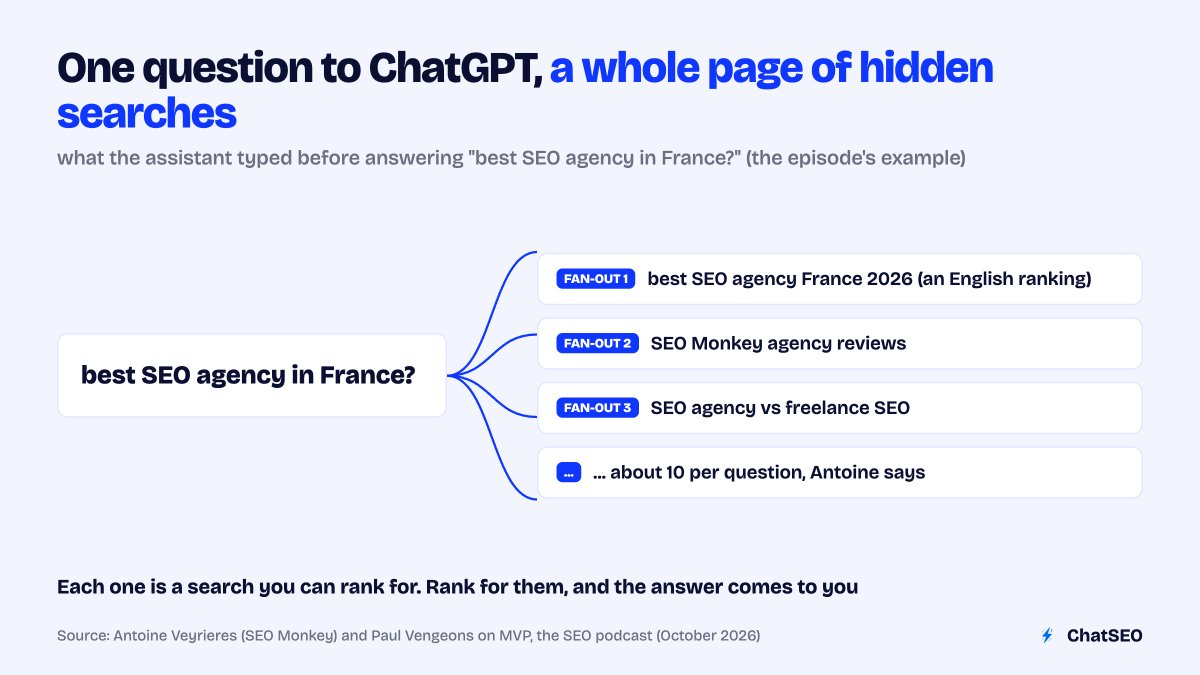
He gave the example from his own world. Someone asks ChatGPT: “what is the best SEO agency in France?”
Here’s the kind of thing the assistant actually searches before answering:
- “best SEO agency France 2026”, in English. It goes and reads an English-language ranking, even for a French question
- “SEO Monkey agency reviews”. It decided to check the reviews of two or three agencies, so it searched for them by name
- “SEO agency vs freelance SEO”. It wants to compare the two options before recommending one
Each of those is a fan-out. Each of those is a search with a results page. And each of those results pages is something you can rank on, or get yourself mentioned on
Antoine’s point is that the scraping goes further than what you’d expect. The model also pulls results you could never rank on yourself, like Wikipedia-type pages, because it wants authority sources. You won’t beat Wikipedia. But you can work every fan-out where a normal page has a chance
And here’s the part that makes it a process instead of a one-off: the fan-outs change. From one month to the next, the same question can trigger different searches. So you pull them regularly, not once
-> The question is the goal. The fan-outs are the keywords. You rank on the keywords
Step 1: pick 5 to 10 target questions. Never 200
This is the rule I liked most, and it’s the one most people break
Antoine’s agency caps every client at 5 to 10 target questions. Maximum. Above that, he says, it becomes completely unmanageable as an objective
At first that sounds tiny. In SEO you’d track hundreds of keywords. But think about what one question really is: each one breaks into about 10 fan-outs. So 10 questions is already around 100 searches to work on. That’s a lot of work for one site
I asked him for a random business to test it live. He picked a carpenter, the kind who builds custom beds
What questions does a carpenter really need to show up on? “Who is the best carpenter in my city?” “How much does a custom bed cost?” Maybe one more about his specialty. That’s it. Very few. And that’s true of almost every business
For his own agency it’s “what is the best SEO agency”, “what is the best GEO agency”, and a couple of long-tail ones. For me with ChatSEO, it’s questions like “what is the best SEO tool”. Very fast, very efficient
It’s the 20/80 applied to GEO. In classic SEO you still worked plenty of long-tail keywords. In GEO, one question already hides the long tail inside its fan-outs, so you need fewer questions, not more
My own version is even smaller: on my own sites, I track 3 to 5 real prompts by hand. The ones a real buyer would type. Not the 300 synthetic prompts a tracking tool invents to fill a dashboard
Here’s the prompt I’d use to pick them:
You are my GEO strategist. My business: [WHAT I SELL, TO WHOM, WHERE]

List the questions a real buyer would type into ChatGPT or Claude right before choosing a provider like me. Only questions with buying intent:
- "best [service/product] for [need]" and "best [service] in [city]"
- price questions ("how much does [service] cost")
- comparisons ("[option A] vs [option B]", "[competitor] alternative")
- review questions ("[competitor] reviews")

Rules:
- Write them the way a person types them, not like keywords
- No informational questions ("what is [topic]")
- Rank them by how close the person is to paying
- Give me 15, then tell me which 5 to 10 you would keep and why
- Do not invent search volumes. If you don't know, say so
-> Ten questions is not a small target. It’s around a hundred searches. Choose them like they cost money
Step 2: pull the fan-outs (by hand, for free)
Now you need to see what the AI actually searches for each question
The free way, which is how Antoine says anyone can do it: go to any assistant, type your target question, and watch the small bubble that appears while it searches. Click it. You can read the path it took: what it searched, which pages it opened
In ChatGPT, Claude and the others, that search step is visible right in the conversation. Copy every sub-search. That’s your list of fan-outs for that question
Then you decline it into a roadmap. One line per fan-out, under its question
A few things I’d add from my own testing:
- Use the assistant your buyers use. Antoine’s agency uses Claude for its own work, but runs the analysis on ChatGPT, because more people use ChatGPT. Track where your buyers are, not where you are
- Use a clean session. Your own history colors the answer. More on that in the share of voice section
- Run each question more than once. The same question doesn’t always trigger the same searches. What comes back every time is what matters
There’s also a source most people ignore, and it’s free: the AI Performance report in Bing Webmaster Tools. It shows when your site is cited in Microsoft’s AI answers, and the grounding queries the AI actually typed to find you. That’s real fan-out data, from the engine itself. I trust it more than any score a third-party tool sells
Here’s the prompt to clean what you copied into a usable list:
Here is what an AI assistant searched before answering the question "[TARGET QUESTION]". I copied it from the search step, across [N] runs:

[PASTE EVERY SUB-SEARCH, ONE PER LINE, WITH THE RUN NUMBER]

Do this:
1. Merge the duplicates and near-duplicates (same intent, different words)
2. For each fan-out, count in how many runs it appeared
3. Sort by that count, most frequent first
4. Next to each, write the intent: comparison, review, price, ranking/list, guide, or other
5. Flag the fan-outs in another language than the question
6. Do not add any fan-out I did not paste
-> The search step is printed on the screen. Most people never click it
How to read a fan-out list (the 4 patterns)
The first time you copy the searches out of the search step, the list looks like noise. After a few questions, you start seeing the same four shapes come back. Each one tells you something different about what to build
1. The language switch. Antoine’s example had it: a French question, and the assistant goes and reads an English ranking. It happens a lot on “best” questions, because the English web has more lists. If your market is French and the fan-out is in English, you have two options: get into the English lists that already rank, or make sure the French version of that page exists and is better. Don’t ignore it because “my clients don’t speak English”. The model does
2. The brand check. “[brand] reviews”, “[brand] opinions”, “[brand] scam”. The assistant has already shortlisted a few names and goes to verify them. If yours is in that search, congratulations, you’re on the shortlist. Now the question is what it reads when it checks you. That’s the reviews and identity work from Step 9
3. The comparison. “[option A] vs [option B]”, “agency vs freelance”, “[tool] alternative”. The assistant is building a table in its head. The page it reads is usually a comparison that already ranks. That’s comparison content, type 1 from the list above, on your site when you can be honest about it, on other sites otherwise
4. The freshness signal. A year in the search (“2026”), “latest”, “updated”. The assistant wants recent sources. A page with an old date, or no date at all, loses this one even if it’s better. Put the date on the page, update it for real, and put the year in the title when the page really is current
When a fan-out doesn’t fit any of these, it’s usually a definition or a how-to. Those are guide territory. One good guide catches many of them at once
-> Four shapes come back on almost every question. Once you see them, the roadmap writes itself
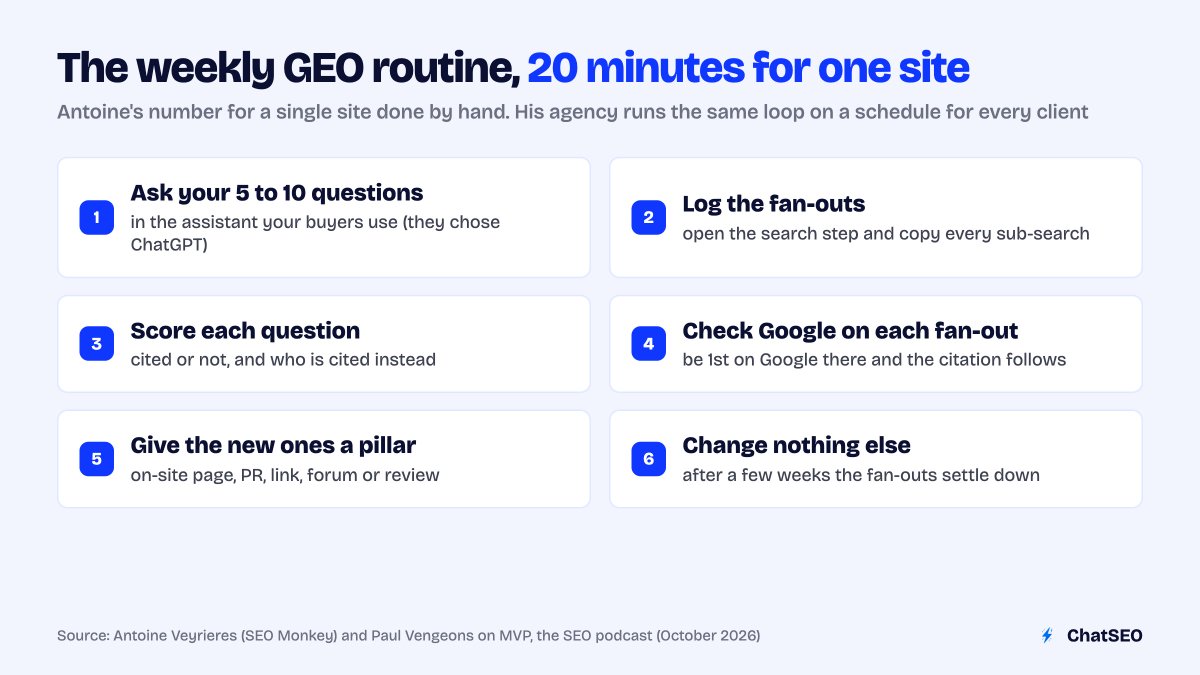
Step 3: do it every week (20 minutes for one site)
Fan-outs move. That’s why Antoine runs this weekly
His agency has an internal tool for it. They call it LLM Tracker. It’s not for sale, it’s a business tool built for their own clients. What it does is simple to describe: for each client it holds the 10 target questions, and every week a small robot goes to ChatGPT, types the 10 questions, updates the fan-outs, and gives a score of how often the client appears
The score reads like this: “you appear one time out of three on ‘what is the best SEO agency in France’”. And it breaks that down on every fan-out too. Then the editorial plan follows from it
But he was very clear on the episode: you don’t need the tool. They built it because they manage a lot of projects. For one site, his number is this: once a week, take 20 minutes, run your 10 target questions, update your fan-outs, update your scores, and adjust your editorial plan
And the reassuring part: after a few weeks, the fan-outs settle. It’s the same ones that keep coming back. The weekly check becomes fast because most of it doesn’t change
Here’s a prompt that turns your weekly notes into the scorecard:
You are my GEO tracker. Here are this week's runs for my site [DOMAIN].

For each target question, I ran it [N] times in [ASSISTANT] from a clean session. For each run I noted: was my site cited (yes/no), which sites were cited, and the sub-searches shown.

[PASTE THE RAW NOTES]

Here is last week's scorecard:
[PASTE IT, OR "none"]

Give me:
1. A table: question, times cited / runs, change vs last week
2. The fan-outs that are NEW this week, and the ones that disappeared
3. The sites cited most often instead of me, with how many times
4. The 3 actions for this week, ranked by how many questions they help
Keep every number exactly as in my notes. Do not estimate anything I did not count
-> Twenty minutes, once a week, on the same 10 questions. That’s the whole tracking budget
Why I would never start with a paid GEO tracker
On the episode I gave my ranking of the three ways to track this, and I’ll give it to you the same way
For someone who is starting, with not much budget, who wants to do it well: the worst option is paying for an external tracking tool. It’s expensive, and in my opinion those tools have biases. They test prompts nobody really types, then sell you a visibility score built on them
The two options I like:
- By hand: the 20 minutes a week above. Free, and you see the real answers with your own eyes
- A small internal tool: if it’s something you need regularly, build it yourself with Claude. It doesn’t take long anymore
And if you have a real budget, several employees, cash in the bank: sure, look at the external tools, there are several (Profound is the best known). If their only product is doing this, you should expect it to be more precise than what you’ll build in an afternoon. That’s logical
But for small sites, and honestly even for good-sized companies, build your own process. You’ll save money
This is also why ChatSEO doesn’t sell a visibility score. On purpose. The real data is free, and the rest is a score on prompts nobody typed
-> A visibility score on invented prompts is a nice chart. Ten real questions a week is a strategy
Build your own tracker with Opus 5.5 (an afternoon)
Here’s where the title comes from
On the episode I went on a little tangent, because I was genuinely shocked that week. I test my AI processes on different models all the time. I had a long period on Claude (Opus 4.5, 4.6, 5), then the ChatGPT Astra hype, so I tested that. Astra is strong, but the models below it weren’t great for me
Then I came back to Claude and now I do everything with Opus. And right now, Opus takes control of my computer and does things for me. Not with a special product. It just drives my machine with Python. It browses websites. It fills in forms. Things where I used to have to check every step, it now does fast, and right the first time
So when Antoine described his weekly robot, my reaction was: anyone can build this now. If tracking your questions is something you’ll do every week, have Opus build you the small tool. I haven’t built mine yet. But if I wanted to follow this seriously, that’s exactly what I’d do
Here’s the brief I’d give it. Adapt it: what’s possible depends on the assistant you track and what its own terms allow
Build me a small weekly GEO tracker for my site [DOMAIN]. Keep it simple: one script, one CSV, nothing to host.

Input: a file questions.txt with my 5 to 10 target questions

Each week, for each question, [N] times:
- Ask it to [ASSISTANT], with web search on, through its official API, from a clean context (no memory, no history)
- Save: the date, the question, the run number, whether [DOMAIN] or my brand "[BRAND]" is cited, every cited URL, and every search the assistant ran if the API returns them

Output:
- results.csv, appended each week (never overwritten)
- a short weekly.md: share of voice per question (cited runs / total runs), change vs last week, new and lost fan-outs, top 5 domains cited instead of me

Rules:
- Before writing code, tell me what the API really returns about searches and citations, and what it does not
- Never fake a field the API does not return: leave it empty and say so
- Add a dry-run mode that costs nothing, and print the cost of a real run before it starts
-> The tool Antoine’s agency built is now an afternoon with a good model. The method is what matters, not the software
Step 4: give every fan-out a pillar
This is where GEO stops looking like SEO on paper, and it’s Antoine’s most useful change
In a classic semantic roadmap, every line is a page you write on your own site. In his GEO roadmap, every fan-out gets a “pillar” column, and the pillar can be anything SEO already knows how to do: content on your site, technical, links, digital PR, forums, reviews
His two examples:
- The question is “what is the best SEO agency”. One fan-out is “SEO agency ranking 2025”. A ranking is not something you publish about yourself. So that fan-out goes to the off-site pillar: digital PR or link building, to get into the rankings that already exist
- Another fan-out is “case study + client name + brand name”. That one makes total sense on your own site. You publish the case study of a client who uses your service. So it goes on-site
![Table infographic: "The GEO roadmap is an SEO roadmap with one more column". Rows: SEO agency ranking 2026 = Off-site (get into lists); [client] case study + [brand] = On-site; SEO agency vs freelance = On-site comparison; [brand] reviews = Off-site (GBP, Trustpilot).](https://web-observer.com/wp-content/uploads/2026/10/geo-guide-04-2110684125388480512.jpg)
And the 20/80 doesn’t change: most of the work is still semantic content on your site, plus off-site semantics, meaning links and PR. Antoine’s rule of thumb: when a fan-out can be won on your own site, don’t overthink it, win it on your site. On-site is so fast and so effective when it’s done well
So the roadmap is one question, about ten fan-outs, and for each one an operational choice: create content on your site, digital PR, a forum, social media, links
Here’s the prompt that builds it:
You are my GEO roadmap planner. Site: [DOMAIN]. Business: [ONE LINE]

Target question: "[QUESTION]"
Its fan-outs (from my tracking, most frequent first):
[PASTE THE LIST]

For each fan-out, give one line:
- The fan-out
- The pillar: ON-SITE (a page on my site) or OFF-SITE (PR, link, forum, review platform, social)
- Why: what kind of page ranks on it today, and whether a page of mine could realistically be one of them
- The exact action: which page to create or update on my site, or which kind of third-party site to get on
- Effort: S, M or L

Rules:
- If a fan-out is a ranking or a "best" list, never propose that I publish my own list with me first. Propose getting into other people's lists
- If it's a review query, point to the review platforms, not to a page I write about myself
- Prefer ON-SITE when a normal page can win it
-> One extra column turns an SEO roadmap into a GEO roadmap. Nothing else changes
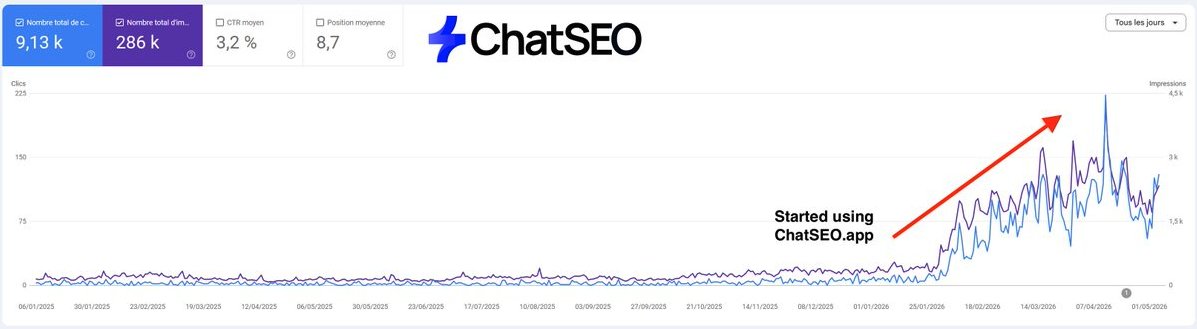
To get similar results for your business: try ChatSEO free for 7 days
The 5 kinds of pages AI assistants cite most
I asked Antoine which fan-outs come back the most across his 400+ clients. Which kinds of pages get scraped and quoted
He gave me a ranked list. Here it is, in his order
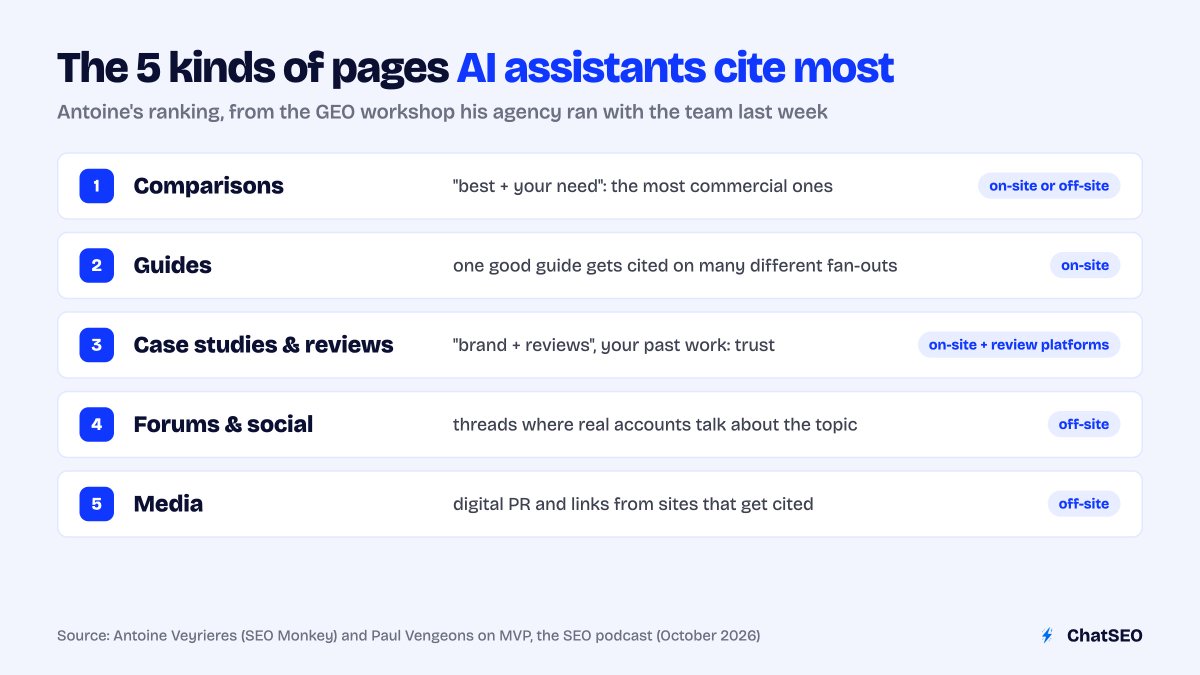
1. Comparisons. The “best + my need” queries. Not “SEO agency” anymore, but “best SEO agency for X”, “best product for this need”. These are the most commercial ones, so they come first
2. Guides. Informational content comes back a lot, through guides. A guide gets cited on a lot of different fan-outs, because it covers many semantic branches. A sales page is cited on its one target query. A great guide, published regularly, is very well scraped by the AIs. That’s exactly why you’re reading one
3. Case studies and reviews. Everything around “reviews + brand” and your past work. It reinforces your authority. It’s your reputation, read by a machine
4. Forums and social networks. Every site where different user accounts interact on the subject of the fan-out. Reddit-style threads, discussions, comments
5. Media. Everything linked to digital PR and link building
So, his summary: 5 to 10 global questions maximum, and 5 kinds of content you can do on your site or off it
My only addition, from my own GEO doctrine: AIs quote passages, not pages. A direct answer in the first lines, a numbered list, a table of facts someone can check. If your comparison page buries the answer in paragraph eight, the model takes someone else’s
-> Comparisons, guides, reviews, forums, media. If a fan-out doesn’t fit one of the five, it probably isn’t worth your week
Step 5: write pages that answer every branch
Antoine had the SOP in front of him and read me what it says about content, whether it’s on your site or on someone else’s
The rule: map the demand, and cover the maximum of questions a buyer can ask, on each page
He described it as a tree of branches. For a buyer, there are:
- The objections: “it’s too expensive”, “I can do it myself”
- The doubts: “does it really work for a business like mine?”
- The fears: “what if it breaks something?”, “what if I’m locked in?”
- The why: why use this at all, why now
- The sources: where the claims come from
- The dates: when it was true, when it was updated
The point is to have content with a lot of internal structure, silos inside your own page, so it can be picked up by the maximum number of fan-outs. One page, many branches, many chances to be the passage the AI quotes
This is not keyword stuffing. Each branch is a real question a real buyer asks before paying. If you answer them all, the human stays and the model has something to quote
Here’s the prompt I’d use before writing or updating a page:
You are my content strategist for GEO. Page: [URL or "new page"]. Main question it must win: "[QUESTION]"

Fan-outs this page should also answer:
[PASTE THE ON-SITE FAN-OUTS FROM THE ROADMAP]

1. List every question a buyer asks before choosing, grouped by branch: objections, doubts, fears, why (use it / now), proof and sources, dates and updates
2. For each, say if the current page answers it: yes, partly, no (quote the passage if yes)
3. For each "no" or "partly", write the answer as a self-contained passage of 40 to 80 words: the answer first, then the fact or the source behind it
4. Propose the section order: the direct answer at the top, then the branches in the order a buyer worries about them
5. Mark every claim that needs a real number or a real example I must provide. Never invent one
-> One page, every branch. The AI quotes the passage that answers, not the page that ranks
Step 6: never put yourself first in your own ranking
On the episode I did the recap of what really differed between GEO and pure SEO since the beginning. It’s a short list
First difference: targeting GEO keywords. The “best X” queries. Those weren’t keywords most of us targeted in SEO before. Affiliate sites always did (“best cordless drill”), but service businesses mostly didn’t. That one stayed. It still matters
Second difference: putting yourself first in your own rankings. You publish “the 10 best [your category]”, you put yourself number one, ChatGPT reads it and repeats it. That worked for a while. It doesn’t work anymore. So that one is gone
I taught that tactic myself, in videos, until the middle of 2026. I stopped, and I had Claude remove the self-rankings from my own sites. The assistants caught on: they now tend to cite the second and third of a list rather than the author who put himself first
So the only thing left is the first one, done differently: you target the GEO keywords, but you don’t really target them with your own site. You target them with OTHER sites that put you first in THEIR rankings, if possible
That’s honestly all you have to remember. That’s GEO. Everything else is classic SEO
What it means in practice:
- Get into other people’s lists. The “best X” articles that already rank and already get cited. That’s the off-site pillar from Step 4
- If you publish a list yourself, rank by truth. Put the real leaders in. Say who each one is for. If you include yourself, disclose it, and don’t take first place. A list where you’re first and everyone else is bad convinces nobody
- Sell yourself on the pages made for it: “[your brand] vs [competitor]” and “[competitor] alternative” pages are where your own site can honestly win
-> The trick that worked was being first in your own list. What works now is being first in someone else’s
Step 7: track a share of voice, not a position
Antoine had a slide on how to measure visibility, and it’s the part that changes the most habits
In SEO, you track a position. Am I 1st, 2nd, 10th, 20th?
In GEO, that doesn’t make sense. An AI doesn’t only have your question. It has the whole history of the person asking. It knows if they live in France, in Paris, in Lille, what they asked last week, what they need. So a position means nothing: the same question gives a different answer to every person
What you track instead is a share of voice: your percentage of appearance across many simulated searches. “Cited in one run out of three”, not “ranked 3rd”
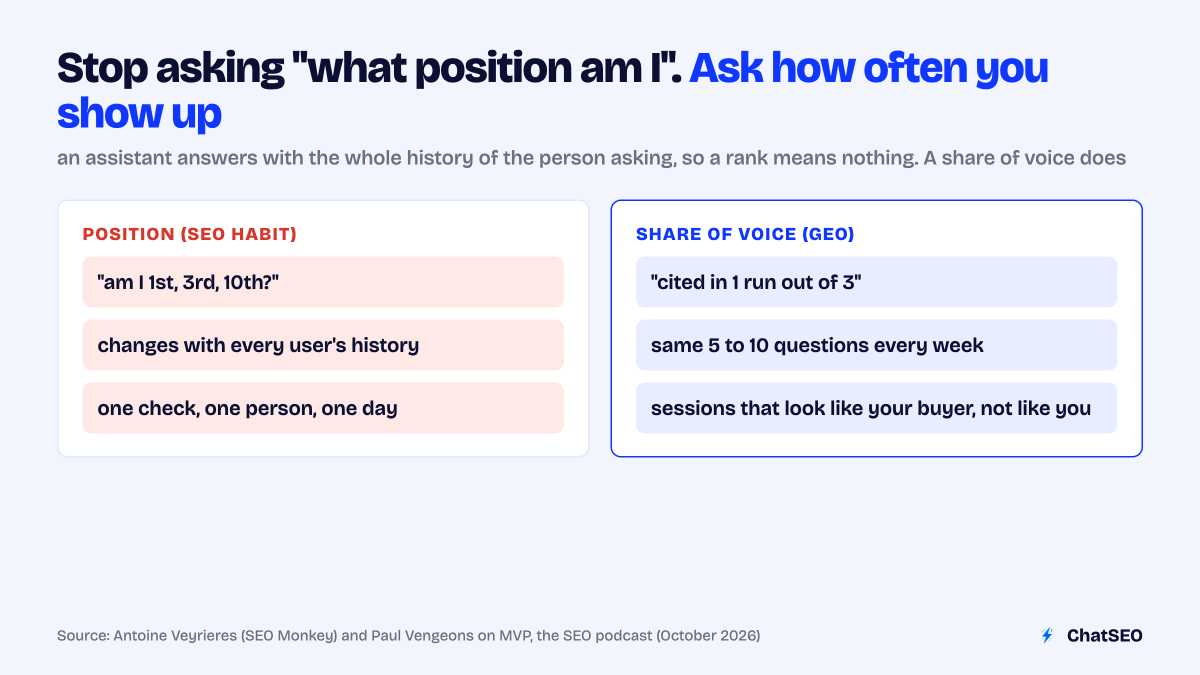
And here’s the subtle part. His agency gives its tracking sessions a history, so the simulated searchers look like the client’s real buyers. He calls it building the persona
His example: you sell dog grooming. Your buyers are a bit of everyone, but on average maybe a bit older, with more budget. The little grandma who takes her poodle to the groomer. Your tracking has to run as people who look like her, not like you
Because if only people like me run the searches, the results will all look the same. Me, and probably everyone who listens to our podcast, will get very similar answers. Run the same search on your mother’s phone, or your grandmother’s, and you may see something different. Especially on broader questions than “best SEO tool 2026”, which is ultra-niche
At agency scale they build that into a global knowledge base for the tracking. On your own, you can do a lighter version:
You are helping me track my share of voice in AI answers, for my site [DOMAIN].

My real buyer: [AGE RANGE, CITY OR COUNTRY, JOB OR SITUATION, BUDGET, WHAT THEY USUALLY ASK]

1. Write 3 short "buyer profiles" that match this person. For each: 3 or 4 everyday questions they would plausibly have asked an assistant in the past weeks, unrelated to my business
2. Write how each profile would phrase my target question "[QUESTION]" in their own words
3. Tell me how to run each profile in a clean session: open a new chat with no memory, ask the 3 or 4 everyday questions first, then the target question in their words
4. Give me the table to fill: profile, run, cited yes/no, who was cited, sub-searches shown
5. Remind me that this is a share of voice: the result is "cited X times out of Y runs", never a rank
-> You don’t rank in an AI answer. You show up, or you don’t, a certain share of the time
Step 8: audit the sources that get cited
The next point on Antoine’s slide: the cited sources
For each target question, his tracking keeps a ranking of the domains that get cited, site by site. Over the weeks you see a history: to appear on “best SEO tools in 2026”, it’s always the same few sites the AI reads
Sometimes it’s a small site. A little digital media cited three times on that question. That’s gold: it becomes a site to contact, for digital PR or a link, so you appear on that fan-out
His comparison is the one that made it click for me. In link building, you look at the link profile of whoever is first on the Google results page, and you know what you need. It’s the same for an AI results page. If every time someone asks “best SEO agency in France”, the same source comes back first in the citations, you absolutely have to get in touch with it. Create your page there, get mentioned, build the relationship
There’s a notion of authority. But there’s also a notion of trust. You audit the answers and you notice: this small site gets cited a lot. Interesting. Go there
Using ChatSEO, for my site [DOMAIN]:

Here are the domains cited in AI answers to my target questions over the last [N] weeks, with how many times each was cited:
[PASTE: question, domain, times cited]

1. Group them by type: media, list/ranking article, review platform, forum, competitor, other
2. For each domain cited 2+ times, read the live Google results for the fan-outs where it appears and tell me if it also ranks there, and on which page
3. Find the exact page that gets cited, and whether my brand is mentioned on it
4. Rank the outreach targets: most cited first, then the easiest to get on (lists that accept additions, review platforms, threads that allow comments)
5. For the top 5, write the angle: why their reader would want my brand on that page. No generic pitch
-> Look at who the AI reads, the way you’d look at the link profile of the #1. Then go be on that page
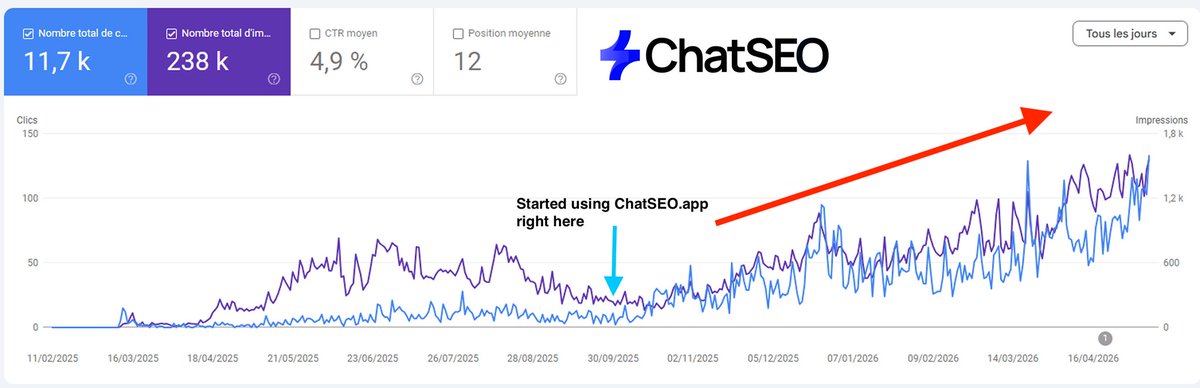
To get similar results for your business: try ChatSEO free for 7 days
Step 9: give the AIs one identity
The last item on the slide was NAP consistency, which Antoine rephrased better: give the AIs one single identity
The idea is trust. You want the maximum of brand mentions, brand citations, on your site and on other sites, all telling the same story. Concretely:
- Your name, address and phone the same everywhere, on your site and in every listing
- Links from your site to your social accounts, and the social accounts actually existing and alive
- A legal notice page, the boring one, because it states who you are
- Your listings: Google Maps, Trustpilot, the review sites of your industry
- Mentions of your brand on other sites, linked or not
All of that is taken into account, fully, in GEO. An assistant that has to recommend a business wants to be sure the business is real and is what it says it is
You are my brand consistency auditor. Brand: [BRAND]. Site: [DOMAIN]. Official name, address, phone: [EXACT NAP]

1. List every place my brand appears that I give you below, and check that the name, address, phone and description match the official ones exactly:
[PASTE: my site footer and legal notice, Google Business Profile, Trustpilot, social bios, directory listings]
2. Flag every mismatch, even small (abbreviations, old address, old phone, different category)
3. Check that my site links to each social account, and that each account links back
4. List the review platforms of my industry where I have no listing yet
5. Give me the fix list in order: biggest trust gap first
-> An AI recommends a business it can verify. Make yourself easy to verify
Step 10: check your Google position on every fan-out
This is the step that closes the loop, and it’s the last sentence of Antoine’s summary: for each fan-out, you track your position on Google
Why Google, when the target is ChatGPT? Because the assistant searches, and it reads what ranks. For ChatGPT, Claude and the others, the search runs on a classic engine. If you’re on page 3 for a fan-out, the model will almost never read you on it. If you’re 1st, the odds flip
So every fan-out on your roadmap gets two numbers next to it, every week:
- Your share of voice on the question it belongs to (Step 7)
- Your Google position on the fan-out itself
When the Google position goes up and the share of voice follows a few weeks later, you know the plan works. When the share of voice is stuck while you’re already 1st on Google, look off-site: the AI is reading someone else’s list, someone else’s review page, someone else’s forum thread. That’s Step 8
Here’s the prompt I’d run for that column:
Using ChatSEO, for my site [DOMAIN]:

Here are the fan-outs from my GEO roadmap, grouped by target question:
[PASTE THE ROADMAP: question, fan-out, pillar]

For each fan-out:
1. Read the live Google results in [COUNTRY], [LANGUAGE]
2. Give my best ranking URL and its position, or "not in top 20"
3. Give the top 3 URLs and what kind of page each one is (list, guide, review, forum, media, competitor page)
4. If the pillar is ON-SITE: tell me which of my pages should rank there, and the one change most likely to move it up
5. If the pillar is OFF-SITE: tell me which of the top 3 pages I should try to be mentioned on
Never estimate a position: if you can't read it live, say so
-> The AI cites what ranks. Your Google position on each fan-out is the leading indicator of your share of voice
The architect, the three accesses and the three bottles of wine
Right after the sponsor break, I told a story on the episode that has everything in it: local, Claude, ChatSEO, and a developer who probably hates me now
My landlord here in Budapest is Hungarian. Every time he comes to collect the rent, we talk business for 10 or 20 minutes. Every time, I show him how ChatSEO is growing. So he understood that it works, and that I do SEO. Around the third or fourth visit, he asked me: honestly, what would you do with my site?
He’s an architect. He designs custom projects, beautiful houses. His site was the kind Antoine knows well: four pages max, pure branding, nothing that targets a search
So I put his site into ChatSEO. We saw interesting things. And I wired everything with the ChatSEO MCP and Claude, on his site
To change everything, I needed three accesses. His blog ran on a CMS (I believe it was Sanity). His Cloudflare, for the HTTP to HTTPS redirects. And his GitHub, because the rest of the site was static
The developer gave me access each time, but never the real one. Editor rights, not admin. Each time I had to push to get the actual access. And once I had it, everything was integrated in two seconds
I did it all in one afternoon. Pages on real Hungarian business keywords. His Google Business Profile, created and already validated
And here’s the detail I told Antoine about. When I created the listing, I put a keyword straight into the name: his company name plus something like “architect Budapest”. I brainstormed it with Claude first: put the normal name and edit it later, or put the keyword directly? Its answer was that the chances of acceptance were higher if I put it directly, because a later edit can trigger a review. So I did. And it went through
Honest note, because I don’t want you to copy the risky part blindly: Google’s rules say the listing name should be the real business name, and keyword stuffing in names can get a listing suspended. I took the risk because his listing didn’t exist before. There was nothing to lose. On a listing with years of reviews, I wouldn’t
That same evening, my landlord came back. He had wanted to pay me at first. I told him no, I’m focused on ChatSEO, I don’t take client work anymore, but the 20/80 for him I can do fast. So he brought me three bottles of good wine
-> One afternoon, three accesses, a site that finally targets searches. The hardest part was getting the admin rights
The GEO habit I had for years without knowing it
Funny fact I realized live on the episode
For fun, I relaunched an affiliate site. It takes me almost no time, because Opus 5.5 does the work while I do other things. I can tell it “take every page of my site, add CTAs, fix this”, go do something else, barely check, and know it’s done right the first time
And a lead came in from ChatGPT. On a site where I never did any GEO
Then I remembered: I have a habit. Whenever I can, I put “best” in the title. Even if the keyword is “cheap cordless drill”, the title becomes something like “Cheap cordless drill: the best one to buy”. Once the main keyword is placed, adding “best” costs nothing, and it potentially adds a lot of GEO queries
That’s exactly the first difference from Step 6: the “best X” queries. I’d been targeting them by reflex for years
My own rule on titles, for both Google and AI: the title is the strongest on-page element you have. Put the main keyword first, then the words that catch the evaluation queries: “best”, the year, “price”, “review”, “alternative”. The year in the title is a cheat code
Using ChatSEO, for my site [DOMAIN]:

Take my pages that target a commercial query (product, service, comparison, category). For each:
1. The current title, and the main query the page gets clicks for in Search Console
2. A new title: the main query first, then the evaluation words that fit honestly ("best", the year, "price", "review", "vs", "alternative"), under 60 characters
3. Only propose "best" or a year if the page really compares options or is really up to date
4. Never change a page that already ranks in the top 3 for its main query: list those separately
5. Give me the old and new title side by side, and the query each one now covers
-> “Best” in the title was GEO before anyone called it GEO
What clients actually ask for
I wanted Antoine’s read on the market, because he talks to more clients than I do
His answer was honest, and a bit old school, in the good sense. He’s been doing SEO for years. He refuses to oversell GEO as “invest massively, it’s do or die”. When people ask for GEO, he does GEO, which is SEO. When people ask for SEO, he tells them they’ll need GEO too, and it’s the same work
What changed is the demand. Everyone is alert on the subject. Everyone understands that more and more traffic comes from the AIs. So demand keeps rising
But for him it isn’t a new demand. People have a budget to get traffic. Sometimes they call it GEO, sometimes SEO, sometimes ads. And to rank in the AIs you do what the web always required: create content, develop sites, get other sites to talk about you. A good SEO trained for years will be good at GEO. It’s not a different job
He also gave a business idea for the agencies and freelancers reading: if you were more sales-driven, you could build a small database and run GEO workshops, or small events exclusively on GEO. It’s a way to get leads, because everyone wants to understand it right now
-> The demand is new. The work isn’t. Sell it honestly and you keep the client after the hype
The whole process on one small business (the carpenter)
Let me put every step together on Antoine’s random example, so you can see what a week of this really looks like. Everything below is a worked example, not a client. Your numbers will be your own
The business. A carpenter in one city who builds custom beds and furniture. Small site, five pages, no blog
Step 1, the questions. Three are enough: “best carpenter in [city]”, “how much does a custom bed cost”, “custom furniture or flat pack, which is better”. That’s it. Three questions, roughly thirty searches behind them
Step 2, the fan-outs. He asks each question three times and copies the searches. He’ll typically see a local list (“best carpenters [city]”), a price search (“custom bed price per square meter”), a review check on two or three names, a comparison (“custom bed vs IKEA bed”), maybe a forum thread
Step 3, the habit. Every Monday, 20 minutes. After a month, most of the fan-outs stop changing
Step 4, the pillars. The price search is on-site: a real price page, with ranges and what drives the cost. The local list is off-site: the existing “best carpenters in [city]” articles, the local directories. The comparison is on-site: an honest “custom vs flat pack” page that says when flat pack is the better choice
Step 5, the branches. The price page answers the fears (“what if it doesn’t fit my room”), the doubts (“how long does it take”), the why (“why not buy one”), with dates and real photos
Step 6, no self-ranking. He doesn’t write “the 10 best carpenters in [city]” with himself first. He asks the local site that already wrote one to have a look at his work
Step 7, share of voice. He runs his three questions as a buyer who looks like his real clients, from a clean session. He notes “cited 1 out of 3” or “not cited”
Step 8, the sources. He notices the same local blog cited on two of his three questions. That’s his first email
Step 9, identity. Same name, address and phone on his site, his Google Business Profile, his directory listings. Photos on the listing. Reviews asked for after each delivery
Step 10, Google. He checks his position on the price search and the comparison every week. When those go up, the citations follow
That’s a complete GEO plan for a five-page site. No tracker, no budget, a few pages and a few emails
-> Small business, small plan. GEO doesn’t need scale, it needs the right ten questions
The 9 mistakes that kill a GEO plan
- Tracking 200 prompts. Past 10 questions it’s unmanageable, and a tool’s synthetic prompts aren’t what buyers type
- Paying for a tracker before you’ve done it by hand once. You won’t know what the score means
- Working the question instead of the fan-outs. You can’t rank for a question. You rank for what the AI searches
- Checking once. Fan-outs move from month to month. Weekly until they settle
- Ranking yourself first in your own list. It used to work. Now it gets you skipped
- Tracking a position. Every answer depends on the person asking. Track how often you appear
- Ignoring the fan-outs in another language. The assistant reads English lists for French questions. If you’re not on them, a competitor is
- Never looking at who gets cited. The small site quoted three times on your question is the cheapest win you have, and most people never open the sources
- Treating GEO as separate from SEO. No rankings on Google, nothing for the AI to find. Roughly one action in ten is GEO. The other nine are SEO
What this does not prove
I want to be straight about the limits
- The 400+ clients are Antoine’s agency. The process comes from his team’s workshop and SOP. It’s how a serious agency runs it today, not a law of nature, and not a promise of results
- The fan-out example is an example. “Best SEO agency in France” is the one Antoine described. Your question will trigger different searches, and they can change from one week to the next
- Share of voice is a sample. “Cited one time out of three” depends on how many runs you did and how close your sessions are to real buyers. Ten runs is an indication, not a measurement
- My landlord’s site is one site. One afternoon, real pages, a validated listing. I’m not claiming rankings or revenue for him here, because I don’t have them to show you
- The affiliate lead from ChatGPT is one lead. It’s an anecdote that made me notice my “best” habit. It’s not a growth curve
- Internal tools have limits. What your tracker can see depends on what the assistant’s API returns. Don’t fill a column with guesses
- Nothing here is a guarantee. GEO results follow SEO results, and SEO is a probability, never a promise
What I would do this week
- Monday: run the first prompt. Keep 5 to 10 target questions, no more
- Monday: ask each question 3 times in the assistant your buyers use. Click the search step. Copy every fan-out
- Tuesday: clean the list with the second prompt. Keep the fan-outs that come back
- Tuesday: open Bing Webmaster Tools and look at the AI Performance report. Note the grounding queries
- Wednesday: build the roadmap. One line per fan-out, a pillar for each: on-site or off-site
- Wednesday: check your Google position on each on-site fan-out. That’s your real gap
- Thursday: update the one page that can win the most fan-outs. Answer every branch
- Thursday: list the 5 domains the AI cites most. Write to the first one
- Friday: fix your identity: same name, address, phone, listings and social links everywhere
- Every week: 20 minutes. Same questions, new fan-outs, the score. Then the work
The real lesson
Antoine summed it up at the end, and I’ll keep his words because I can’t do better
If you remember one thing, the 20/80 is this notion of having very few target questions. If you want to do GEO tomorrow on your brand, you have between 5 and 10 GEO questions, max. You take each one. You go to an assistant, you run it, you look at its fan-outs. You do that once a week, because it moves, and after a few weeks it’s always the same ones. And for each fan-out, you track your position on Google
Because in the end, you have to be first on Google on each fan-out. And then, naturally, you get cited by the AIs
That’s the whole thing. GEO is SEO on the searches the AI makes for you
No dashboard to buy, no new job title to hire, no secret file to add to your site. Ten questions, the searches behind them, a page or a mention for each one, and twenty minutes every Monday to see what moved. Start with the first prompt this week, on your own business, and keep the list short
The full episode, in French, with Antoine Veyrieres on MVP: https://www.youtube.com/watch?v=jt54RCZxICg
Thanks for reading!
🎁 If you want to hire your first AI SEO employee (for free), click here
Leave a Reply
You must be logged in to post a comment.