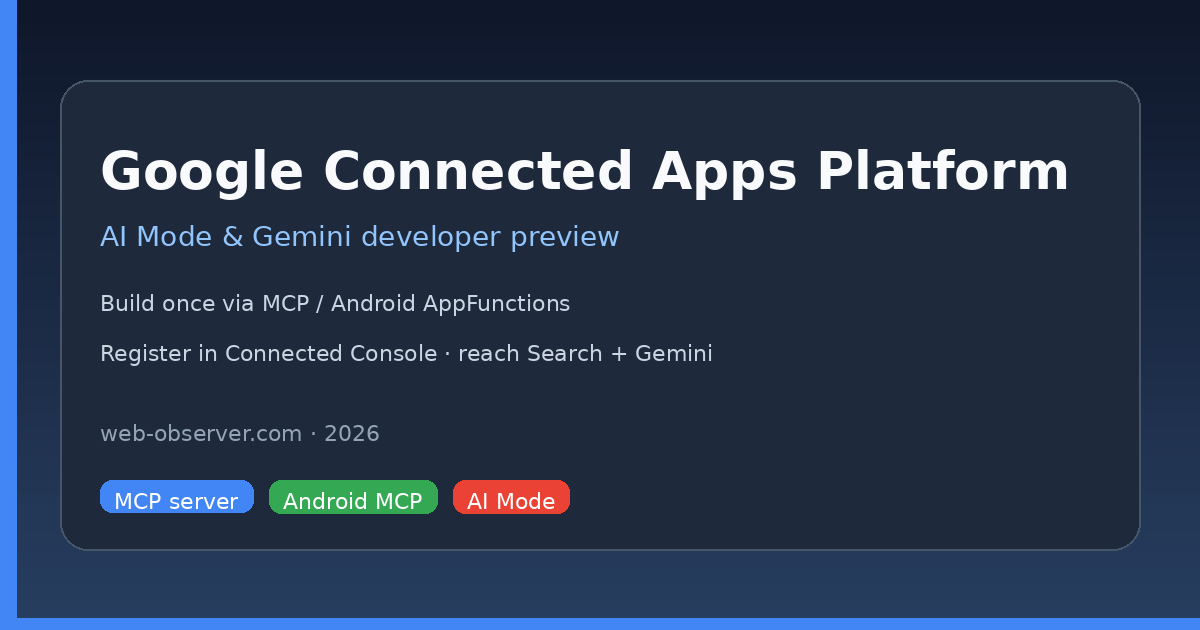
Publisher / product takeaway: On October 28, 2026 Google opened a developer preview of the Connected Apps Platform — a single path to build once (via a cloud-hosted MCP server or Android MCP / AppFunctions), register in the Google Connected Console, and reach users inside Search AI Mode and the Gemini app. SEJ’s October 31 write-up (and Robby Stein’s “public preview” note) makes the SEO angle clear: apps that pass review can be selected when AI Mode routes a task. This is complementary to our morning piece on Alphabet Q3 AI Mode monetization — that post covers ad RPM pressure; this one covers agentic distribution and brand visibility inside the same surfaces.
Primary sources: Google’s Connected Apps Platform announcement, the Connected Apps developer hub, Search Engine Journal (Matt G. Southern), and TechCrunch. Live Search AI Mode apps (U.S. English) currently include Instacart, Canva, YouTube Music, Yahoo Fantasy Football, and Sleeper; Google says 50+ Connected Apps across Search and Gemini, with Adobe, Experian, Localiza, and Peloton moving from Gemini toward Search and Calm launching on both.
What the Google Connected Apps Platform is
Connected Apps already let people link a third-party service once, then complete real actions — grocery orders, design drafts, playlists — inside Search AI Mode or Gemini without bouncing to a separate browser session for every step. The platform preview is Google’s attempt to productize that pathway: instead of bespoke partner deals only, more developers can apply, build against standard protocols, submit for review, and monitor traffic, latency, and error rates after go-live.
Google’s blog (Chips Mistry / Mai Lowe) frames it as “build once and reach high-intent users across both Search and the Gemini app,” with brand control (verified logos, authenticated accounts) retained by the developer. Access is phased: U.S. developer preview / waitlist first, with more developers, markets, and Google products promised over coming months.
How MCP server vs Android MCP (AppFunctions) works
The platform standardizes two integration paths documented on Google’s Connected Apps hub:
- MCP server (cloud / remote): You expose tools and authorized data over the open-standard Model Context Protocol. Google’s docs position this as the path to engage users across applicable Google products — including Gemini and Search users on web, Android, and iOS (per SEJ’s reading of Google’s guidance). OAuth 2.1 is used so Gemini/Search can act on a user’s behalf after they link the app. You can also design richer UIs with MCP Apps.
- Android MCP (AppFunctions): AppFunctions are Android’s MCP solution. This is a client-side / on-device path: the Jetpack AppFunctions SDK lets an Android app share native features with agents such as Gemini on Android. Tool execution happens locally on the device — useful when data or actions should stay on-device rather than round-tripping through your cloud.
| Dimension | MCP server (remote) | Android MCP (AppFunctions) |
|---|---|---|
| Protocol / SDK | Model Context Protocol (cloud-hosted server) | Jetpack AppFunctions (Android MCP) |
| Where tools run | Your remote server | On the user’s Android device |
| Reach (per Google / SEJ) | Gemini + Search users on web, Android, iOS | Gemini users on Android |
| Auth pattern | OAuth 2.1 for user-authorized access | Device-local app capability sharing |
| Best when | Cross-surface actions + personal account context | On-device features / local execution |
| UI options | MCP Apps for richer interactive UI | Native Android app surfaces |
Analysis: Product and SEO teams should not treat these as interchangeable. If your goal is visibility inside Search AI Mode on the open web, the remote MCP path is the one that maps to that surface. Android MCP is still strategic for Gemini-on-Android retention, but it is not a substitute for Search distribution.
Registration, categories, review, and anti-gaming policy
Onboarding during preview is self-service via the Google Connected Console: register tools, run tests, submit for review and publishing, then monitor usage. Developers choose whether the app goes live in Search, Gemini, or both, and specify country / language / product availability.
- Category lock: You pick a category that defines minimum capabilities; SEJ notes the prerequisites page says the category cannot be altered after registration.
- Capability list: Identify at least three capabilities shown to users when they decide whether to connect.
- Test accounts: Sign-in apps must provide Google with test accounts and sample data; an app Google cannot fully test may be rejected.
- Anti-gaming / model-selection policy: Connected apps must not deceive or influence the model into adverse behavior — for example using overly broad or deceptive capability descriptions to get selected over another Connected App. Apps also cannot reference other tools or invent rules for when other tools should be used, and must not push third-party ads/promotional materials inside the integration (own brand info is allowed).
- Enforcement: Rejection, suspension, removal from the platform, or developer-account suspension/termination.
Google’s MCP server guide (as cited by SEJ) says models rely on server instructions to recognize when to delegate — so clear, accurate capability text is both a policy requirement and a routing requirement. This is closer to honest tool metadata than classic keyword stuffing: overclaiming can get you rejected, not ranked.
What’s live today (Search AI Mode vs Gemini)
Per Google Help / SEJ, Connected Apps operating in Search AI Mode for U.S. English today include:
- Instacart
- Canva
- YouTube Music
- Yahoo Fantasy Football
- Sleeper Fantasy Football
Google says it has launched more than 50 Connected Apps across Search and Gemini (productivity, ticketing, health/fitness, and more). Partner integrations such as Adobe, Experian, Localiza, and Peloton are live for Gemini users and, in the coming weeks, are expected in Search as well. Calm is launching a new integration across both Search and Gemini.
On the user side, AI Mode may default to the last app used for a task; users can specify another app or pick from available apps after a general query. That UX detail matters for product owners: retention and “last-used” habit can compound once you are in the catalog.
Why it matters for visibility on the agentic web
TechCrunch put it bluntly: similar to how SEO helped companies show up in rankings, Connected Apps could be an early step for businesses that want services visible when AI agents reshape browsing. For publishers and product owners reading this site, the practical map looks like this:
- Citation / retrieval still matters for answers — see getting cited in AI search and schema markup for AI search — but action surfaces (book, buy, design, play) may route to Connected Apps rather than blue links.
- AI Mode is already a different traffic and ad surface — Reddit’s claim that AI Mode does not drive traffic and Alphabet’s admission of lower AI Mode monetization are about referrals and RPM. Connected Apps are about who owns the completion moment when Google does keep the user in-product.
- Preferred sources and generative controls remain relevant for content discovery (AI Mode preferred sources, Search Console generative AI control), while Connected Apps are a parallel track for productized services.
- Measurement: if you ship a Connected App, instrument AI Mode / Gemini sessions separately — reuse patterns from tracking AI referral traffic in GA4 and add Connected Console latency/error metrics as product KPIs.
John Mueller (Google Search Advocate) called Connected Apps exciting as a search platform while stressing it is “still extremely early” and noting he does not work on the product — a useful calibration: treat this as a strategic watchlist item, not a guaranteed traffic channel.
Practical checklist for publishers, SEO, and product owners
- Decide if you have an “action” product (commerce, booking, creative, media, health) that belongs in AI Mode / Gemini — not every publisher site needs a Connected App.
- Join the U.S. developer preview waitlist at developers.google.com/connected-apps if you do; access is phased.
- Prefer remote MCP when Search AI Mode reach (web + iOS + Android) is the goal; use Android MCP when on-device Gemini features matter.
- Write narrow, truthful capability descriptions — policy forbids gaming model selection with broad/deceptive claims; clear instructions also improve routing.
- Lock category and ≥3 capabilities carefully before registration (category cannot be changed later per prerequisites notes).
- Prepare test accounts + sample data so Google’s review can fully exercise sign-in flows.
- Choose Search vs Gemini vs both deliberately; dual presence compounds habit/default-last-app behavior.
- Keep classic SEO / citation work — Connected Apps do not replace ranking, AI citation eligibility, or generative Include/Exclude decisions in Search Console.
- Plan analytics for AI Mode sessions and Connected Console traffic/latency/errors separately from organic SERP clicks.
- Watch the Adobe / Calm / Peloton Search rollout as a signal of how fast the Search catalog expands beyond today’s five U.S. EN apps.
FAQ: Google Connected Apps Platform for AI Mode and Gemini
What is the Google Connected Apps Platform preview?
It is Google’s October 28, 2026 developer preview for building once (MCP server or Android AppFunctions), registering in Google Connected Console, and publishing apps that run inside Search AI Mode and/or the Gemini app after Google’s review.
How do MCP server and Android MCP differ?
A remote MCP server exposes tools over Model Context Protocol and, per Google/SEJ, can reach Gemini and Search users on web, Android, and iOS. Android MCP via AppFunctions runs tools locally on Android and primarily serves Gemini users on Android.
Can I write broad capability text to get selected more often?
No. Google’s Connected Apps policy bars overly broad or deceptive capability descriptions meant to influence the model into selecting your app over another. Violations can lead to rejection, suspension, removal, or account termination.
Which Connected Apps are live in Search AI Mode today?
For U.S. English Search AI Mode, Google’s help materials list Instacart, Canva, YouTube Music, Yahoo Fantasy Football, and Sleeper. Google reports 50+ Connected Apps across Search and Gemini overall, with more partners (including Adobe, Experian, Localiza, Peloton, and Calm) expanding.
Is this a replacement for SEO or AI citation work?
No. Connected Apps target in-product actions and linked account context. Classic rankings, preferred sources, generative AI controls, and citation/retrieval quality still govern how content is discovered and referenced. Treat Connected Apps as a complementary agentic-distribution channel.
Who can apply, and where?
The platform is in U.S. developer preview / waitlist. Sign up and read docs at developers.google.com/connected-apps. Google says it will add more developers, markets, and Google products over the coming months.
Bottom line: The Google Connected Apps Platform preview turns AI Mode and Gemini into a reviewed app marketplace with MCP and Android AppFunctions as the pipes, Connected Console as the control plane, and an explicit ban on gaming model selection. For publishers and product owners, it is the distribution counterpart to AI Mode’s lower ad monetization and weaker referral stories — if Google keeps users in AI Mode, the brands that complete the task may be Connected Apps, not classic blue links. Apply if you have a real action product; keep citation SEO if you publish content.