Tag: SEO

  • Google URL Structure Best Practices (2026): Hyphens, Underscores, and Crawlable URLs

    Google URL Structure Best Practices (2026): Hyphens, Underscores, and Crawlable URLs

    Publisher takeaway: On October 23, 2026, Google refreshed its URL structure best practices to clarify word separation: use hyphens (-) instead of underscores (_) when you split words in paths and query keys. The update is a documentation sync (tied to Google’s “The Non-Canonical Cabinet” video series), not a sudden ranking flip — but it is the clearest official stance yet for anyone still debating URL structure SEO, permalinks, and crawlable parameters.

    If you have been shipping AI Mode and GEO explainers (we covered Google’s official generative AI SEO guide recently), this is a useful pivot back to foundational technical SEO: crawlable URLs, faceted-nav traps, and a practical WordPress/permalink checklist. The changelog entry is listed on Google Search documentation updates under October 23, 2026.

    What changed on October 23, 2026

    Google’s updates page summarizes the change as: updated guidance on crawlable URL structures to clarify word separation guidelines using hyphens versus underscores — synchronized with episodes of “The Non-Canonical Cabinet.” In other words: the live URL structure doc now spells out why hyphens are preferred, not only that they are preferred.

    The rest of the page still covers the hard crawlability requirements (IETF STD 66 / RFC 3986-style URLs, no content-changing fragments, common parameter encoding) plus best practices (descriptive paths, audience language, percent encoding, fewer parameters, case sensitivity, multi-regional patterns) and common explosion issues (additive filters, session IDs, calendars, broken relative links).

    Hyphens vs underscores: Google’s reason

    Google recommends separating words in URLs when possible. Specifically, it recommends hyphens (-) instead of underscores (_) because that helps users and search engines identify concepts in the URL.

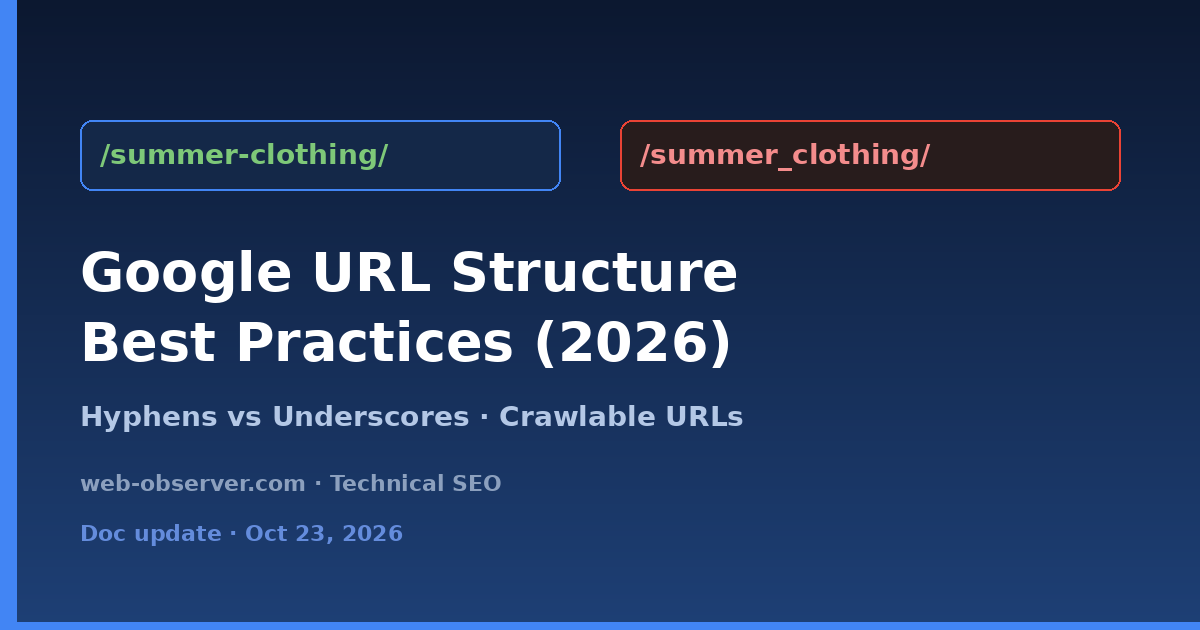
    The historical rationale Google now documents: underscores are commonly used in programming to keep tokens together (for example format_date), whereas hyphens clearly signal a word boundary. So /summer-clothing/ reads as two concepts; /summer_clothing/ looks more like one glued identifier.

    • Recommended: https://example.com/summer-clothing/filter?color-profile=dark-grey
    • Not recommended: underscores as separators — https://example.com/summer_clothing/filter?color_profile=dark_grey
    • Also not recommended: joining words with no separator — https://example.com/greendress

    Practical SEO note: do not mass-rename years of live URLs overnight for a hyphen cosmetic pass. If you migrate, plan 301s, update internal links and sitemaps, and watch Search Console coverage. Prefer hyphens on new content and on redesigns where you already own the redirect map.

    Hard requirements for a crawlable URL structure

    Before style choices, Google states that if URLs fail basic criteria, Search may crawl the site inefficiently — including extremely high crawl rates — or barely crawl it at all. Requirements called out on the doc:

    • Follow IETF STD 66: reserved characters must be percent-encoded. Google Search supports URLs as defined by that standard (see RFC 3986 for the familiar URI reference).
    • Don’t use URL fragments to change content: Google Search generally does not support fragments for content variants. Avoid patterns like https://example.com/#/potatoes. If JavaScript changes content, use the History API instead of hash routes for indexable states.
    • Use common encoding for URL parameters: separate key-value pairs with = and join additional parameters with &. Multiple values for one key can use a non-conflicting character such as a comma.

    Parameter encoding examples from Google:

    • Recommended: ?category=dresses&sort=low-to-high&sid=789
    • Not recommended: colon/bracket styles like ?[category:dresses][sort:price-low-to-high]
    • Recommended multi-value: ?category=dresses&color=purple,pink,salmon&sort=low-to-high
    • Not recommended: comma-as-pair-separator patterns like ?category,dresses,,sort,lowtohigh

    Recommended vs not recommended URL patterns

    Use this sheet when reviewing permalinks, ecommerce filters, or CMS templates. Left column tracks Google’s examples and best practices; right column is the anti-pattern.

    Recommended (URL structure SEO)Not recommended
    Descriptive words: /wiki/AviationOpaque IDs only: /index.php?topic=42&area=3a5ebc…
    Hyphen word breaks: /summer-clothing/Underscores: /summer_clothing/ or glued words: /greendress
    Audience language in the path (e.g. German/Japanese words when that is the audience)ASCII-only junk strings when readers search in another language
    Percent-encode non-ASCII in href when neededRaw non-ASCII or emoji paths without encoding in links
    Key=value&key=value parametersColon/bracket or double-comma parameter schemes
    Few parameters; drop ones that do not change contentSession IDs, referral junk, every sort/filter combo as indexable URLs
    Consistent case if the server is case-insensitivePublishing both /Apple and /apple as separate pages
    History API for JS stateHash fragments that swap main content

    Make the structure easy for humans (and Google)

    Beyond crawlability, Google recommends a simple, logical structure that is intelligible to people — aligned with the broader SEO Starter Guide advice on site structure:

    • Descriptive URLs: readable words beat long ID numbers when you can.
    • Audience language: match the language (and transliteration) your audience searches in.
    • Percent encoding: unreserved ASCII can stay as-is; non-ASCII should be percent-encoded in links.
    • Fewer parameters: trim parameters that do not change content.
    • Case sensitivity: Google treats /APPLE and /apple as distinct. If your server folds case, normalize to one casing so duplicates collapse cleanly.
    • Multi-regional: country domains (example.de) or locale subdirectories (example.com/de/) help geotargeting when used consistently.

    Common pitfalls: faceted navigation and parameter explosion

    Overly complex, multi-parameter URLs can create huge numbers of near-duplicate URLs. Googlebot may burn bandwidth or fail to index important content. Issues Google highlights:

    • Additive filtering: combining beach + fitness + “value rates” hotel filters multiplies URL space even when the underlying inventory is the same set of hotel detail pages.
    • Irrelevant parameters: click IDs, referrers, shopping sort params, and especially session IDs in URLs — prefer cookies for sessions and block junk patterns in robots.txt when needed.
    • Infinite calendars: unrestricted past/future date links; use nofollow on open-ended future calendar links when appropriate.
    • Broken relative links: parent-relative links on the wrong page can invent infinite path spaces; prefer root-relative URLs and correct 404s.

    If Google is already crawling problematic URLs, Google recommends blocking them via robots.txt when appropriate (dynamic search results, infinite calendars, ordering/filtering functions) and following dedicated guidance on managing crawling of faceted navigation URLs. Pair that with crawl-budget hygiene and, when AI crawlers are in scope, the same robots discipline we outlined for robots.txt AI crawler allow/block rules.

    WordPress / permalink checklist

    Concrete steps for a typical WordPress site (including Twenty Twenty-Five + AIOSEO stacks like ours):

    1. Settings → Permalinks: use a post name structure such as /%postname%/. Avoid default plain ?p=123 for public content.
    2. Slugs: write lowercase, hyphen-separated focus phrases (google-url-structure-hyphens-underscores-2026), not google_url_structure_….
    3. Don’t change published slugs casually: if you must, add a redirect (AIOSEO Redirects or server rules) and update internal links.
    4. Taxonomies: keep category/tag base paths short and hyphenated; avoid deep nested category URLs that add no user value.
    5. Ecommerce / filters: decide which facet combinations are indexable. Canonicalize or noindex thin filtered views; don’t let every sort= and color= variant enter the sitemap.
    6. UTM and tracking: fine for campaigns, but strip them from canonicals and don’t bake session tokens into links shared sitewide.
    7. Sitemaps: submit only canonical, content-bearing URLs; re-check after a permalink migration.
    8. Internal links: link with descriptive anchors to stable paths — the same clarity that helps classic SEO still supports retrieval and citation paths discussed in getting cited in AI search retrieval.

    How this fits your broader tech SEO work

    Clean URL structure SEO does not replace content quality or eligibility controls. It reduces crawl waste so Googlebot (and your own monitoring) can spend time on pages that deserve indexing. Keep generative-AI eligibility and controls in Search Console as a separate layer — see our Search Console generative AI control walkthrough — and treat URL hygiene as the plumbing underneath both classic results and AI surfaces.


    FAQ

    Does Google still recommend hyphens over underscores in 2026?

    Yes. The October 23, 2026 documentation update reaffirms recommending hyphens (-) instead of underscores (_) to separate words in URLs, with an explicit historical explanation about underscores keeping programming-style tokens together.

    Will changing underscores to hyphens boost rankings overnight?

    Treat it as a clarity and crawlability improvement, not a magic ranking lever. Migrate carefully with redirects. Google’s update was framed as clarifying documentation (and syncing with a video series), not announcing a new scoring feature.

    Are underscores a penalty?

    Google does not describe underscores as a spam penalty. It simply does not recommend them for word separation and notes the historical programming convention. Prefer hyphens for new URLs.

    Should faceted filter URLs be indexed?

    Usually only a small, intentional subset. Additive filters explode URL counts. Use robots.txt, canonicals, and faceted-navigation crawl management so Googlebot reaches product/detail pages without crawling every combination.

    Do fragment (#) URLs get indexed as separate pages?

    Google generally does not support URL fragments for changing page content. Don’t rely on hash routes for indexable states; use the History API for JavaScript-driven content changes you want crawled.
  • Google’s Official Guide to Generative AI SEO (2026): What Actually Matters for AI Mode

    Google’s Official Guide to Generative AI SEO (2026): What Actually Matters for AI Mode

    Publisher takeaway: Google’s official guide to optimizing for generative AI features is blunt: generative AI SEO is still SEO. AI Overviews and AI Mode are grounded with retrieval-augmented generation (RAG) and query fan-out against the same Search index and quality systems you already optimize for. The wins come from non-commodity, people-first pages that are indexed, snippet-eligible, and included via Search Console — not from llms.txt, micro-chunking, or inauthentic “mention” campaigns.

    We already published a shorter overview of Google’s AI search optimization guide and a deep ops walkthrough of Search Console generative AI control. This piece is the practical playbook for publishers who care about generative AI SEO specifically for AI Mode: how retrieval works, what content actually stands out, which myths to ignore, how eligibility stacks, and how to measure without inventing metrics.

    Is SEO still relevant for generative AI search?

    Yes. Google states that generative AI features on Search are rooted in core Search ranking and quality systems. They use AI techniques to highlight content from the Search index — they do not replace the need for crawlability, helpful content, or spam-policy compliance.

    You will see the labels AEO (answer engine optimization) and GEO (generative engine optimization) everywhere. From Google Search’s perspective, optimizing for generative AI search is still optimizing for the search experience — i.e., SEO. If you buy third-party “AEO/GEO” packages, Google points you back to evaluating third-party SEO advice against official guidance.

    How AI Mode finds your pages: RAG + query fan-out

    Two mechanisms in the official guide explain why classic relevance still wins and why thin “AI answers” rarely earn citations:

    • Retrieval-augmented generation (RAG) / grounding: Search retrieves relevant, up-to-date pages from the index, then reviews specific information on those pages to generate a more reliable response — with prominent, clickable links to supporting pages.
    • Query fan-out: The model issues concurrent related queries to fetch more results. Google’s example: a user asks “how to fix a lawn that’s full of weeds”; fan-out might include “best herbicides for lawns”, “remove weeds without chemicals”, and “how to prevent weeds in lawn”.

    Practical implication for generative AI SEO: one strong page that answers a cluster of related questions with unique evidence often beats a swarm of near-duplicate “fan-out keyword” pages. Google explicitly warns that creating separate pages primarily to manipulate rankings or generative AI responses can violate scaled content abuse. For how retrieval systems think about chunks vs graphs in broader AI search, see our GraphRAG vs vector RAG comparison — useful context, not a Google ranking lever.

    Create non-commodity content (the long-term lever)

    Google’s strongest long-run claim in the guide: unique, compelling, useful content will likely influence presence in generative AI search more than any other suggestion. Attributes they call out:

    • Unique point of view: First-hand reviews and experienced takes beat recycled summaries that a generative model could produce.
    • Non-commodity vs commodity: Commodity (“7 Tips for First-Time Homebuyers”) restates common knowledge. Non-commodity (“Why We Waived the Inspection & Saved Money: A Look Inside the Sewer Line”) goes beyond ordinary advice with expert or lived detail.
    • Human-readable structure: Clear paragraphs, sections, and headings help readers — and make it easier for systems to surface the relevant passage.
    • High-quality images and video: Generative AI features can pull media, expanding appearance beyond blue links. Follow existing image and video SEO practices.
    • Do not over-produce variants: Focusing on every possible query variation mainly to game AI Mode is both spammy and a weak long-term strategy; Google’s AI systems understand relevance even without exact query–title match.

    If you use generative AI tools to draft, your output still must meet Search Essentials and spam policies. Simplify decisions with Google’s own test: would visitors find this satisfying? Pair that with helpful, reliable, people-first content guidance.

    Technical structure still gates eligibility

    Generative AI features only see what classic Search can find and serve. The guide restates:

    • Meet Search technical requirements so a page can be indexed and shown with a snippet.
    • Additionally, the site must be included in Search generative AI features in Search Console to be eligible for display in those features.
    • Stay crawlable; for large, frequently updated sites, mind crawl budget.
    • Semantic HTML helps humans (e.g., screen readers) more than it “unlocks” AI Mode; perfect HTML is not required.
    • Follow JavaScript SEO best practices if you rely on client rendering.
    • Page experience, mobile display, and less duplicate content remain worthwhile.

    Indexing and serving are never guaranteed even when you check every box. For the Include / Exclude / Inherit toggle and inheritance quirks, use our Search Console generative AI control playbook. Keep Googlebot allowed — see robots.txt for AI crawlers for how Googlebot vs Google-Extended differ.

    Do / Don’t for generative AI SEO (publisher sheet)

    Use this as a one-page brief for editors and freelancers. Left column matches Google’s guide; right column is the trap list.

    Do (Google guidance)Don’t (common myth / hack)
    Ship unique, experience-backed pages that answer real jobs-to-be-doneMass-produce commodity tip lists for every fan-out query
    Keep pages indexed, snippet-eligible, and Included in Search generative AIAssume llms.txt, special AI Markdown, or “AI schema” is required for Google
    Organize with clear H2/H3 and support with strong media when usefulMicro-chunk every paragraph “for the model” as a ranking requirement
    Measure with Search Console’s Generative AI performance reportTrust third-party tools that claim internal Google AI ranking scores
    Earn authentic discussion through useful workBuy or manufacture inauthentic “mentions” across blogs and forums
    Keep structured data for rich-result eligibility where it already helpsAdd special schema.org types solely “for AI Mode”
    Prepare agent-friendly UX if browser agents matter to your businessRewrite every page into an unnatural “AI-only” voice

    Mythbusting: what Google says you can ignore

    The guide’s myth section is the fastest way to cut wasted sprint time:

    • llms.txt and special AI markup: Google Search does not use them for generative AI visibility. Fine to keep for other systems; they neither help nor hurt Google Search.
    • Mandatory chunking: No requirement to break content into tiny pieces. Google can understand multi-topic pages and surface the relevant part. Page length should follow audience needs.
    • Rewriting only for AI systems: Synonyms and intent matching already work — you do not need every long-tail variant on-page.
    • Inauthentic mentions: Generative features can reflect web discussion, but spam systems and quality systems still matter; manufactured mentions are not a shortcut.
    • Overfocusing on structured data: Not required for generative AI search; no special schema is needed. Continue ordinary structured data for rich results.

    Eligibility stack before you chase AI Mode citations

    Think in layers — each layer fails independently:

    1. 1. Discoverable & indexable: Crawlable, not blocked, not noindexed accidentally.
    2. 2. Snippet-eligible in classic Search: Meets technical requirements for Search.
    3. 3. Search Console generative AI = Include (or Inherit that resolves to Include) on the property that owns the decision.
    4. 4. Content quality / retrieval match: Non-commodity answers that map to fan-out-style related questions — see how to get cited in AI search retrieval.
    5. 5. Product surfaces on top: Preferred Sources enrollment and link UI (inline links, carousels) — covered in Preferred Sources and AI Mode inline links — do not replace layers 1–4.

    Measure with the Generative AI performance report

    Google’s recommended measurement surface is the Generative AI performance report in Search Console (Performance → Generative AI). Use it to see how people discover your content through generative AI features on Search. Be wary of third-party tools promising ranking success or “internal” Google metrics — Google states no third-party tool has access to internal ranking or AI systems.

    Ops rhythm we recommend after the August 31, 2026 global control rollout: confirm Include, export a 28-day generative AI impressions baseline by page, refresh the top URLs with answer-first intros and unique evidence, then reconnect impressions to sessions in analytics. Full toggle semantics live in the control article.

    Brief note: agentic experiences and browser agents

    The same Google guide ends with emerging agentic experiences: AI agents that book, compare, or gather data on a user’s behalf. Browser agents may analyze screenshots, inspect the DOM, and use the accessibility tree. If that is relevant to your product and you have bandwidth, review Google’s agent-friendly website best practices and watch protocols such as Universal Commerce Protocol (UCP) as they mature. For most content publishers, this is awareness — not a reason to abandon foundational SEO this quarter.

    30-day generative AI SEO sprint

    1. Week 1: Audit Search Console generative AI control on every verified property; screenshot Include/Exclude/Inherit. Export Generative AI performance baseline.
    2. Week 2: Pick 5–10 URLs with (or near) generative impressions. Upgrade commodity sections into non-commodity proof: data, screenshots, first-hand steps, failure cases.
    3. Week 3: Fix technical blockers (indexing, JS rendering, thin duplicates). Confirm Googlebot access. Do not invent llms.txt workstreams for Google.
    4. Week 4: Re-export the report. Strengthen internal links across your AI/SEO cluster. Pitch one mid-size vertical site with an evergreen related to your unique angle — not a farm.

    FAQ: generative AI SEO and Google’s official guide

    Does generative AI SEO mean SEO is obsolete?

    No. Google’s official guide says best practices for SEO remain relevant because generative AI features rely on core Search ranking and quality systems, plus RAG and query fan-out over the Search index.

    What is the difference between SEO, AEO, and GEO?

    AEO and GEO are industry labels for work aimed at AI answers. Google Search treats optimizing for generative AI features as part of optimizing for Search — still SEO. Evaluate third-party AEO/GEO claims against Google’s published guidance.

    Do I need llms.txt or special schema for AI Mode?

    Google says you do not need llms.txt, special AI markup, or special schema.org types to appear in generative AI features on Google Search. Structured data remains useful for rich results, not as an AI Mode requirement.

    How do I know if my site can appear in AI Overviews or AI Mode?

    Pages need to be indexed and snippet-eligible, and the Search Console property must Include the site in Search generative AI features. Then improve non-commodity content and retrieval match. Measure with the Generative AI performance report.

    Should I create a page for every query fan-out variation?

    No. Google warns that producing separate pages primarily to manipulate rankings or generative AI responses can violate scaled content abuse. Prefer fewer, deeper pages that cover related intents with unique evidence.